7 mins read

Fintech stocks fell harder than the wider market on 5 November 2026, when the S&P 500 dropped 4.36% to 7,353.73, its worst day since April 2025, and the Nasdaq Composite lost 5.52% to 24,315.00, according to Yahoo Finance closing data. Robinhood closed down 10.3% at $78.39, SoFi fell 7.7% and Affirm 7.8%. Fintechbits checked the regular-session closes of 14 US-listed companies in its fintech stocks directory: six fell further than the Nasdaq, led by Dave, down 18.1%, and Chime was the only one to rise.
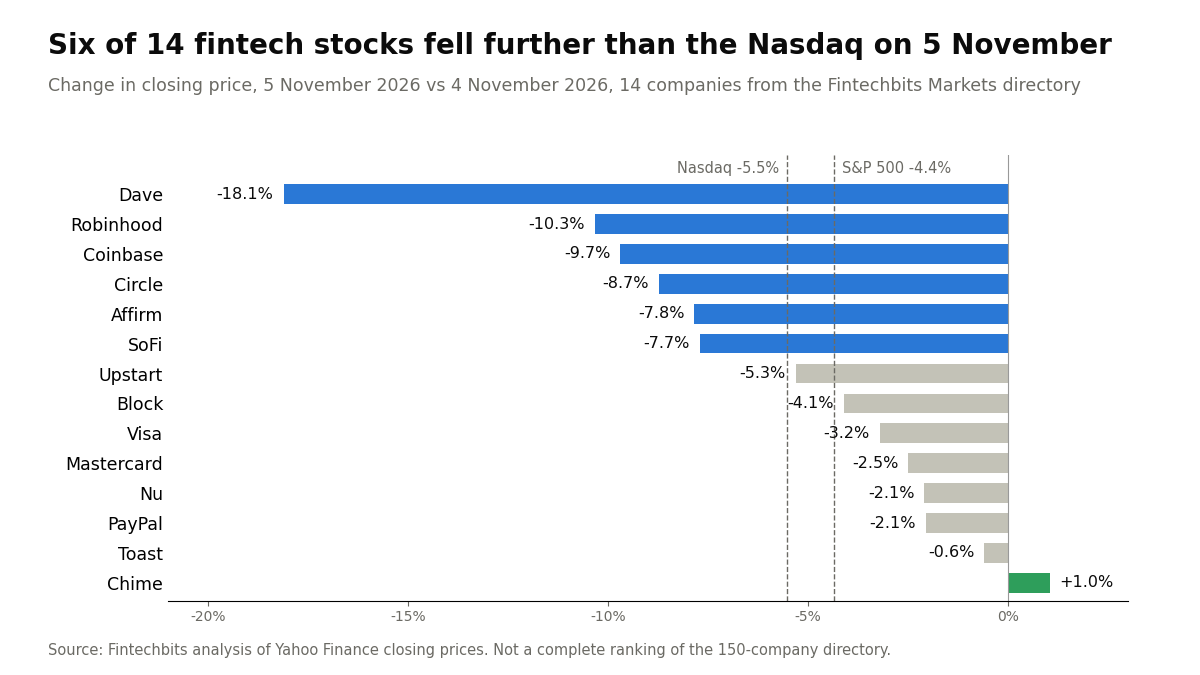
Hardest hit in the sample: Dave down 18.1%, Robinhood down 10.3%, Coinbase down 9.7%
Most resilient: Chime up 1.0%, Toast down 0.6%, PayPal and Nu down 2.1%
Bitcoin: below $76,000, from about $80,400 a day earlier
How far did fintech stocks fall on 5 November?
The sell-off started in chip and AI stocks and spread to every sector of the S&P 500. It also erased a rally on 4 November that followed the US midterm results, when the Dow rose 3.03%. Retail-facing fintech stocks took some of the worst of it. The table below shows the 14 directory companies Fintechbits checked, ranked by their move from the 4 November close.
| Company | Ticker | Close, 5 Nov 2026 | Change vs 4 Nov |
|---|---|---|---|
| Dave | DAVE | $275.34 | -18.1% |
| Robinhood | HOOD | $78.39 | -10.3% |
| Coinbase | COIN | $136.82 | -9.7% |
| Circle | CRCL | $69.48 | -8.7% |
| Affirm | AFRM | $69.66 | -7.8% |
| SoFi | SOFI | $16.04 | -7.7% |
| Upstart | UPST | $22.14 | -5.3% |
| Block | XYZ | $84.04 | -4.1% |
| Visa | V | $422.59 | -3.2% |
| Mastercard | MA | $655.92 | -2.5% |
| Nu | NU | $11.74 | -2.1% |
| PayPal | PYPL | $58.96 | -2.1% |
| Toast | TOST | $35.16 | -0.6% |
| Chime | CHYM | $30.18 | +1.0% |
The split is clear. Companies whose revenue rises and falls with retail trading or crypto prices, Robinhood, Coinbase and Circle, all fell more than 8.7%. Consumer lenders SoFi and Affirm fell nearly 8%. The card networks and PayPal fell less than the S&P 500, and Chime, which reported results after the close on 4 November, finished higher.
Fintechbits analysis
Why Robinhood fell 10%
Robinhood is the clearest case of a business priced on retail activity. Bitcoin dropped below $76,000 on 5 November from about $80,400 a day earlier, and crypto is a business line Robinhood already knows can shrink fast. In its third-quarter results on 27 October, Robinhood reported cryptocurrency revenue of $120 million, down 55% from a year earlier, while event contracts revenue rose more than sixfold to $173 million. Total net revenue still reached a record $1.42 billion.
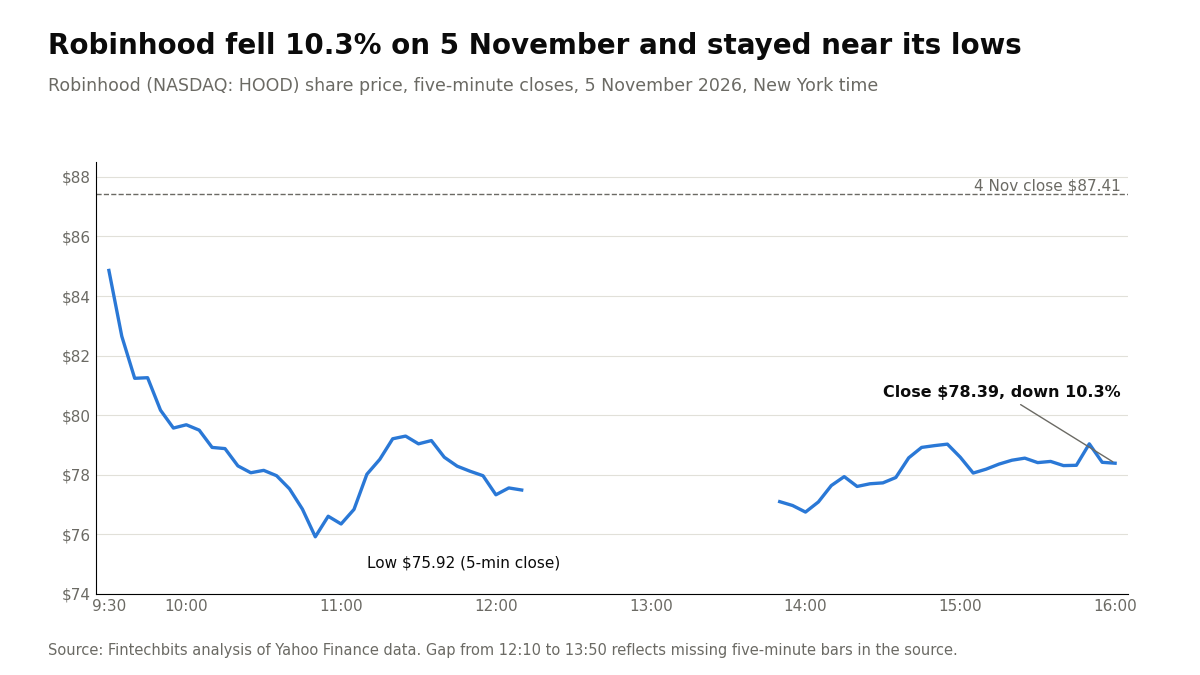
The intraday chart shows how the day went. Robinhood opened near $85, fell below $76 before 11:00 in New York and spent the afternoon between $77 and $79. After 11:10 it never traded back above $80.
Robinhood’s diversification helps, but most of its newer revenue still depends on customers trading. Volatile markets can lift volumes, so a falling share price does not always mean falling revenue. The test is whether November trading data show active customers pulling back.
SoFi and Affirm: good results did not protect them
SoFi’s fall came little more than a week after a strong quarter. Fintechbits reported that SoFi’s third-quarter results showed adjusted net revenue up 44% to $1.4 billion and a raised full-year forecast. That did not stop the stock dropping 7.7% to $16.04. Investors were selling growth and consumer credit exposure, not reacting to anything SoFi reported.
Affirm fell 7.8% to $69.66 with no company news, ahead of its fiscal first-quarter report. Buy now, pay later lenders depend on consumer spending and on funding markets staying open, and both look less certain when risk appetite collapses in a single session.
Why PayPal and the card networks held up
PayPal fell 2.1% and Block 4.1%, roughly in line with or better than the S&P 500. Visa and Mastercard fell 3.2% and 2.5%. These companies earn most of their revenue from payment volumes and fees rather than from trading activity or loan books, and PayPal’s third-quarter results showed revenue growth of only 2%. A stock priced for slow growth has less premium to lose.
The 5 November move is a useful reminder that fintech stocks no longer trade as one group. Dave, the consumer banking app, fell 18.1%, more than three times the Nasdaq’s drop, while Chime, which serves a similar customer base, rose. Company news explains part of that gap. The rest is positioning: investors cut the names most exposed to retail trading, crypto and unsecured credit first.
Washington added to the pressure. Coverage on the day linked part of the fintech selling to Democrats’ gains in the midterm elections and what a different Congress could mean for crypto legislation and consumer finance rules. Those consequences will take months to show up, if they do at all, so the immediate drivers were bitcoin and the AI-led sell-off.
Methodology
Fintechbits compared regular-session closing prices on 5 November 2026 with closes on 4 November 2026, using Yahoo Finance data, for 14 US-listed companies in the Fintechbits fintech stocks directory. The 14 were chosen to cover payments, digital banking and lending, trading and crypto. They are not a complete ranking of the 150 companies in the directory. Closing prices can differ slightly between data providers. The Robinhood intraday chart uses five-minute closing prices from the same source.
Frequently asked questions
Which fintech stocks fell the most on 5 November 2026?
Of the 14 directory companies Fintechbits checked, Dave fell the most, down 18.1%, followed by Robinhood (10.3%), Coinbase (9.7%) and Circle (8.7%), according to Yahoo Finance closing data.
How much did Robinhood stock fall?
Robinhood closed at $78.39 on 5 November 2026, down 10.3% from $87.41, after trading as low as $75.51 during the session.
Did any fintech stocks rise?
Yes. Chime rose 1.0% to $30.18, the only gain among the 14 fintech stocks Fintechbits checked.
What to Watch Next
The next readings are company data rather than share prices. Affirm’s fiscal first-quarter results will show whether credit performance is holding, and Robinhood’s monthly operating data for November will show whether crypto and equity trading slowed. A recovery in bitcoin would help the crypto-exposed names first. Readers can follow the companies in the banking and lending, trading and investing, crypto and payments sections of the Fintechbits Markets directory.
This article is for information only and is not investment advice.