4 mins read
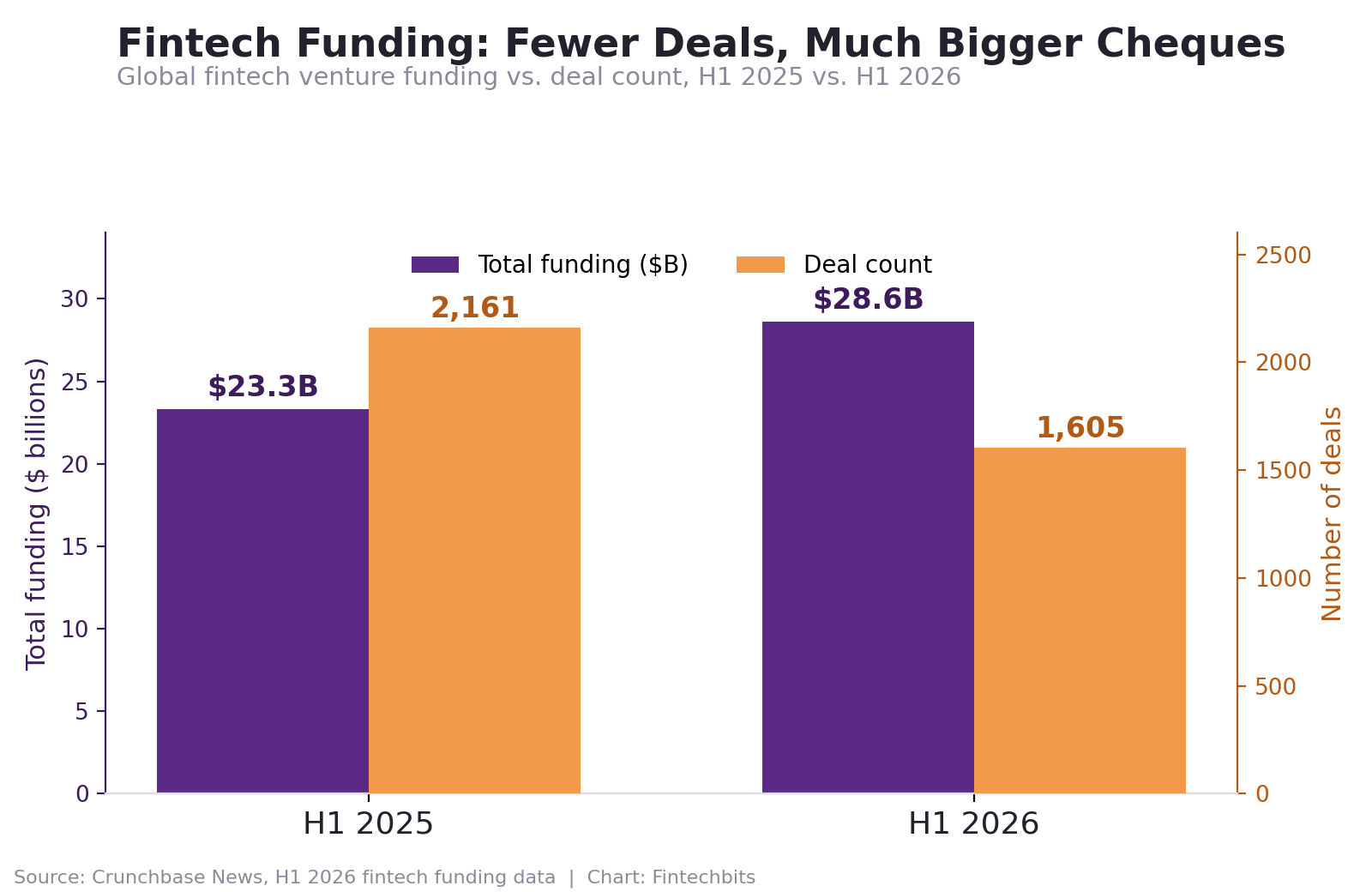
Fintech funding H1 2026 hit $28.6 billion globally, according to data compiled by Crunchbase News, a 22.7% increase over the same period last year. On its own, that headline number reads like a recovery story. The deal count tells a different one. Just 1,605 funding rounds closed in H1, a 25.7% drop year-over-year, and funding was also down 17.3% from H2 2025’s $34.6 billion. Investors aren’t spreading capital more widely across the sector. They’re concentrating it.
That combination, more money and fewer deals, is the real story of fintech funding H1 2026, and it lines up with what KPMG’s long-running Pulse of Fintech series has also tracked this cycle: a market where later-stage, well-capitalized companies are absorbing a growing share of available capital while early-stage founders compete for a shrinking pool of first cheques. Run the numbers and the average deal size roughly jumped from $10.8 million in H1 2025 to $17.8 million in H1 2026. That’s not a market getting more generous. It’s a market getting more selective and writing the survivors bigger cheques.
Where the money went
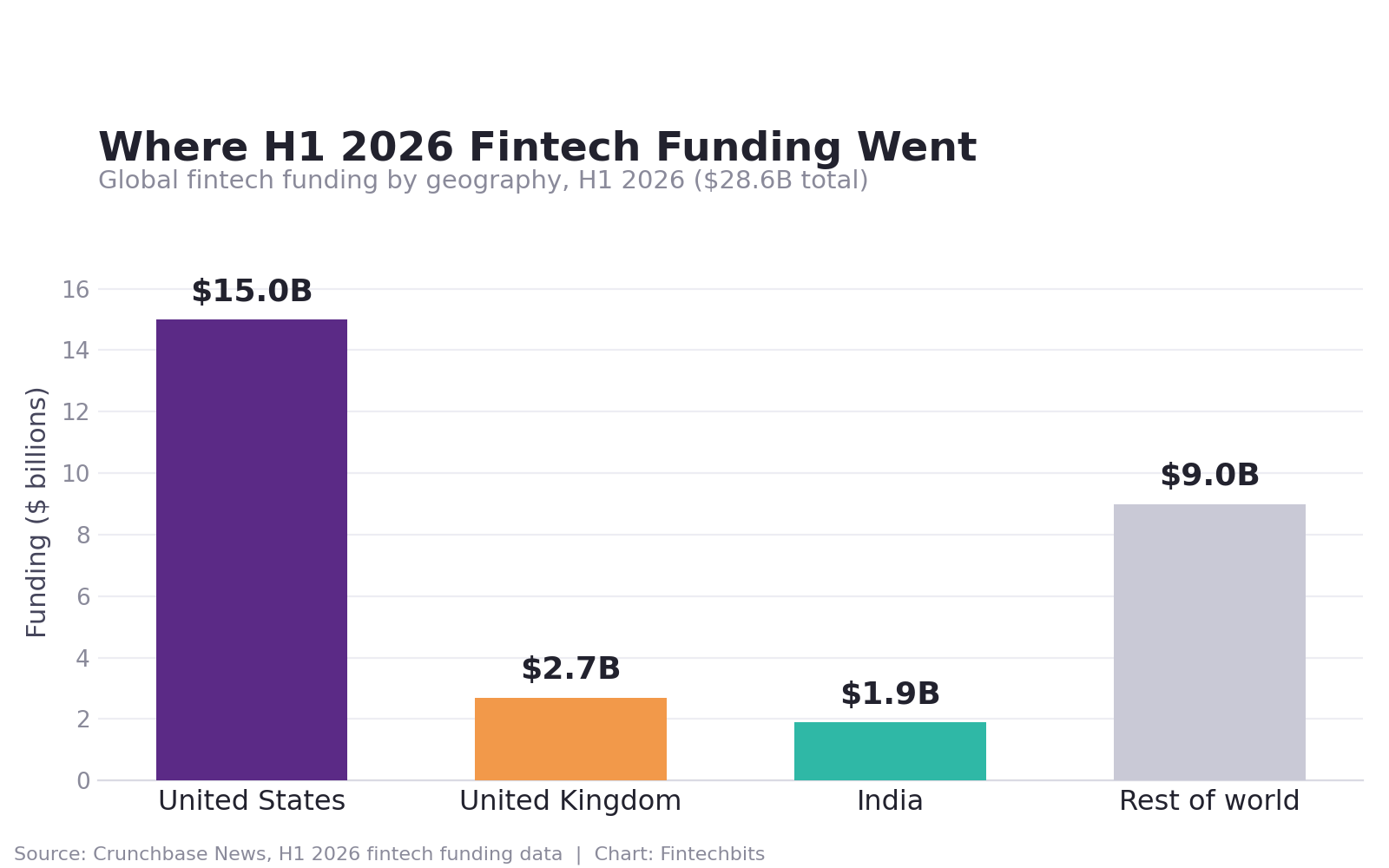
Geographically, the US alone accounted for $15 billion of the H1 total, a bit over half of all global fintech funding, with the UK a distant second at $2.7 billion and India at $1.9 billion. That concentration matters for anyone tracking where the next generation of fintech infrastructure gets built. The US isn’t just leading, it’s pulling further ahead of the next two markets combined.
By sector, the money followed a familiar 2026 pattern for anyone who’s been reading Fintechbits’ AI coverage this year: wealth management, financial infrastructure, enterprise automation, and AI-powered financial tools drew the largest concentrations of capital, alongside continued investment in money-movement infrastructure and blockchain-based asset tracking. None of that is a surprise to anyone following the AI-in-finance beat closely, but seeing it show up this clearly in the H1 aggregate data is useful confirmation that the trend isn’t just a narrative investors are telling each other. It’s where the cheques are actually going.
Two rounds stood out as signals of what concentrated capital looks like in practice. Taktile, an agentic banking platform, closed a $110 million Series C led by Goldman Sachs Alternatives, a reminder that “agentic” isn’t just an AI-industry buzzword anymore. It’s showing up in how banks and lenders are automating decisioning. And Flutterwave, the African payments company, raised a Series E that valued it at $3.2 billion, a sign that payments infrastructure outside the US and Europe is still attracting serious late-stage capital even as overall deal volume contracts.
The pattern isn’t limited to those two. Helcim’s $53 million Series C closed this August with credit unions writing the cheque, and Fasset’s SBI-led $68 million raise pushed the stablecoin neobank to a $1 billion valuation days after the H1 window closed, both consistent with a market rewarding companies that already have traction over ones still proving the concept.
What fewer, bigger deals means for the rest of the market
For founders and operators outside the small group closing nine-figure rounds, this fintech funding H1 2026 data points to a market that rewards proof over promise. With deal count down more than a quarter year-over-year, investors are being more selective at every stage, and the bar for a first or second cheque is higher than it was a year ago. That’s consistent with anecdotal reporting from earlier-stage fintech founders throughout 2026, who have generally described longer diligence cycles and more emphasis on unit economics than growth-at-any-cost metrics.
For the embedded finance and stablecoin infrastructure companies Fintechbits covers regularly, the read-through is a bit more encouraging. Both categories fall inside the financial infrastructure bucket that pulled disproportionate investor interest in H1, suggesting the thesis behind embedded finance and stablecoin rails as durable infrastructure, rather than a speculative trend, is increasingly shared by institutional investors and not just by the founders building in the space.
The pattern to watch
The fintech funding H1 2026 story sets the tone for what comes next. If this pace holds, the rest of the year isn’t going to be about whether capital keeps flowing. It clearly is, at a higher dollar volume than a year ago. It’s going to be about how narrowly that capital concentrates, and whether the gap between well-funded infrastructure and AI-native platforms and everyone else keeps widening. We’ll be tracking the H2 2026 numbers when they land later this year, along with a closer look at how much of the AI-powered financial tools category is genuinely AI-native versus existing fintech products adding an AI feature to fit the moment.
Sources: Crunchbase News, “Fintech Funding Surges 23% In H1 2026 As Investors Concentrate Their Bets On AI And Financial Infrastructure”; KPMG, Pulse of Fintech H1 2026.