9 mins read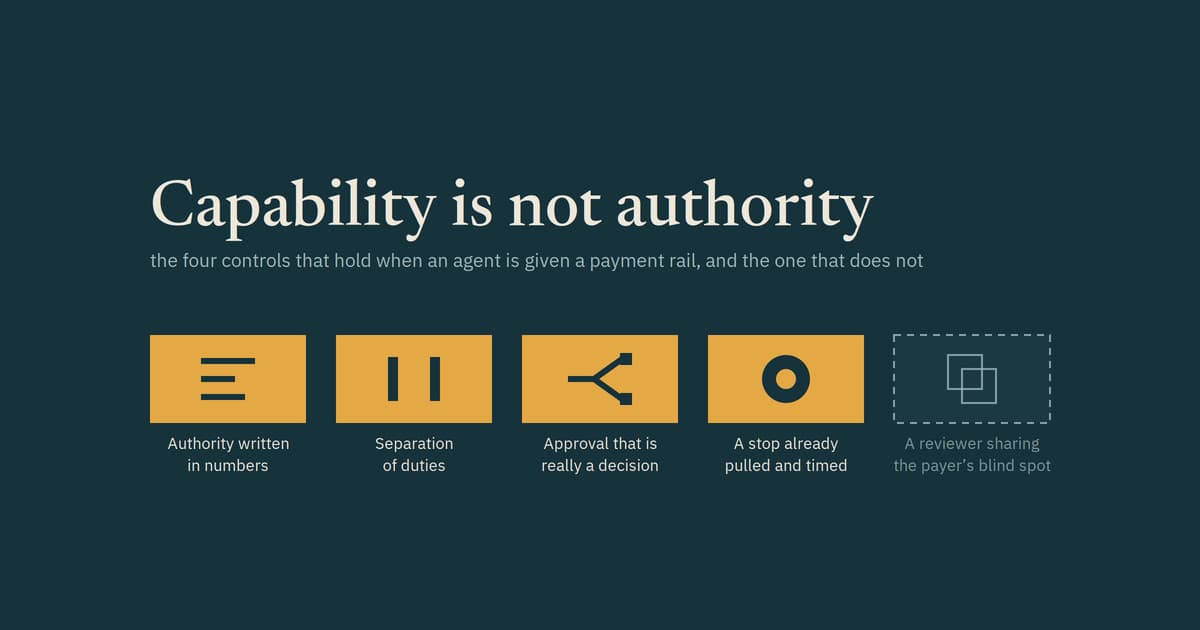
By Master Joe Phillips, Founder, Master Joe Phillips
AI agent payments were not the first version of this problem I met. There was no AI in the room at all. An operations lead was told to raise sales. He raised sales. He did it by discounting, and the margin went with it. He had done exactly what we asked. What we wanted was a different thing, and nobody had written it down. The objective had one dimension and the business had two.
The AI agent payments version of that failure has a name, incomplete specification, and it is old. What is new is the speed. Put the same gap behind an API key and a payment rail and the discount does not happen once a quarter. It happens four hundred times before anyone opens the dashboard.
I run companies where money moves. Electronic invoicing, collections, billing operations. When agentic tools arrived promising to settle, refund and disburse on their own, my first reaction was not excitement or fear. It was a boring administrative question: who authorised that, and how would I prove it?
Capability Is Not Authority in AI Agent Payments
In AI agent payments the vendor declares capability. Your organisation grants authority. Two different acts, by two different parties, with two different exposures, and the market blurs them daily.
When a salesperson says their agent handles refunds end to end, that is a claim about what the software can do. It is probably true. The authority to touch your accounts and commit your company does not come in the box. You grant it, and you grant it the way a hospital grants an operating theatre: in stages, against evidence, with a withdrawal already designed. Confusing the two is how organisations discover an agent’s real spending authority by reading logs after the fact.
Four AI Agent Payments Controls That Hold Up
Four AI agent payments controls have earned their place. One popular control has not.
Authority written in numbers, before the agent runs. Per transaction cap. Daily aggregate. Counterparty allowlist. Currencies. And the list of things it may never do at any amount. Written first, never inferred later from what the agent turned out to be doing. If your authority matrix lives in a config file only an engineer can read, you do not have an authority matrix. You have a setting.
Separation of duties, the oldest AI agent payments control. Whoever initiates does not approve. This rule is older than computers and does not care whether the initiator is a person or a process. It is the single control that survives contact with almost every failure mode here.
Approval that is really a decision. Here is my test. Can the approver reframe the case and decide differently? Someone facing two hundred agent recommendations a day, clearing them at a pace that makes understanding impossible, is not supervising. They are signing. That looks like a nuance until a regulator or counterparty asks who decided, and the honest answer is nobody.
A stop that has been pulled before you needed it. No pilot performs their first engine shutdown on a burning engine. They have done it in the simulator, timed, with an instructor. Ask when the AI agent payments kill switch was last exercised, who holds it at two in the morning, and what happens to work in flight. A stop nobody has tested is not a control. It is decoration.
The control that does not hold is a reviewer agent checking a paying agent when both run the same model from the same vendor. Your reviewer shares the exact blind spot of the thing it reviews, and approves with enthusiasm the errors the executor makes. Reliability engineering has called this common cause failure for decades. The novelty is the speed, and the fact that one degraded vendor can take your whole artificial workforce down the same afternoon.
The Question That Decides an AI Agent Payments Dispute
When AI agent payments go wrong, what happened is the easy part. Every system logs that.
The question that settles the argument is why. Which policy applied. Which data the decision rested on. Which tools it called. Which authority it operated under. Which version of the model, the prompt, the knowledge base and the rules were live that second. If your vendor pushed a model update on a Tuesday and nobody revalidated, Wednesday’s payment agent is a different employee wearing the same name badge. A version is a record, not a proof.
One AI agent payments warning that costs people real money. Do not accept the system’s own account of why it paid. Ask a model to explain itself and you get a fluent, confident narrative that reads like evidence and is not. Operational evidence can be disputed: a data point gets corrected, a policy gets challenged, an authority gets shown to be absent. A reasoning story cannot be falsified. Your counterparty cannot dispute a vibe, and neither can you.
Where AI Agent Payments Liability Sits
With you. AI agent payments liability does not travel down the chain and does not transfer to the vendor. Three consequences belong in your contracts before the first agentic payment clears.
AI agent payments vendor claims belong to deployments, not platforms. A blanket compliance claim means nothing. The useful questions are which customer deployment, where the declaration is published, and when it expires. A platform can enable a compliant deployment. A platform cannot be one.
Blame follows causes, not proximity. The clerk at the end of the workflow is not responsible by virtue of standing nearest the button. If the design forced a rubber stamp, the design is the cause, and that is where the finding should land. Any governance model that turns the last human into a shock absorber will lose that human, and deserve to.
Some decisions stay human whatever the AI agent payments economics say. Credit. Access to essential services. Anything with legal effect on a person. An agent can analyse and recommend. Deciding alone, never.
Reversal Is a Legitimate AI Agent Payments Result
In February 2024 Klarna announced its OpenAI assistant had handled 2.3 million conversations in a month, two thirds of customer service across 23 markets and 35 languages, work the company described as equivalent to 700 full-time agents, with about $40 million in projected annual savings. Fifteen months later, in May 2025, the same CEO said publicly that the cost cutting had gone too far, and Klarna returned to hiring human agents so customers always had the option of a person.
Apply this article’s own standard to that case and it gets more interesting. The 700-agent figure was a modelled equivalence, not a headcount action, describing work volume rather than people dismissed. The satisfaction claim was published without a score or a sample size. Every headline number was self-reported by the party with an interest in it, which is precisely the failure I warn about above. If you would not accept an agent’s account of why it paid, do not accept a vendor case study on the same terms.
I do not read the reversal as an AI agent payments failure. I read it as a rebalance, and a good one. What it shows is that the return conditions were discovered afterwards. Write them before the pilot: what error rate is unacceptable, how much human intervention destroys the economics, which incident forces suspension, which external change invalidates the design. Written before you know the result, those are criteria. Written after, they are justification.
Fintechbits analysis
Why I Wrote a Standard for AI Agent Payments
Because I kept writing the same AI agent payments memo. Different company, different process, same five questions, and nothing to cite. In HR you can point to a policy. In finance you can point to a control framework. For an artificial resource holding a budget, everyone was improvising privately and calling it strategy.
So I wrote it down. Twenty-seven normative clauses, published openly in English and Spanish. Authority explicit, limited and revocable. High risk actions carrying human approval with separation of duties. Reserved matters no artificial system decides alone. Every material action auditable back to its determinants. Conformance belonging to a deployment, never a product.
Two decisions I will defend to anyone. I gave myself a voice and no vote in its governance, so no future version depends on my continuing to agree. And the text freezes on 1 September 2026 whether or not a review board is seated, because a standard its author keeps quietly patching is not a standard. It is a personal document with pretensions. The conformance clause also forbids any platform from claiming compliance for itself. Mine included. That was the point.
If you are about to authorise AI agent payments, start here. Write its authority in numbers and get someone with budget responsibility to sign those numbers. Name one person who can stop it, and give them the power to stop it rather than the power to file a request. Pull that stop once, on an ordinary Tuesday, and time it. Write the return conditions before the pilot begins.
The technology question is whether the agent can pay. The management question, and the one AI in finance keeps failing, is whether you can show who decided that it should.
Joe Phillips builds and operates billing, invoicing and collections platforms in Costa Rica, and is the author of the Hybrid Workforce Standard, an open administrative standard for governing AI Employees.
Fintechbits covers payments infrastructure, AI governance and financial operations. Nothing here constitutes financial or investment advice. All analysis represents the editorial views of Fintechbits.