7 mins read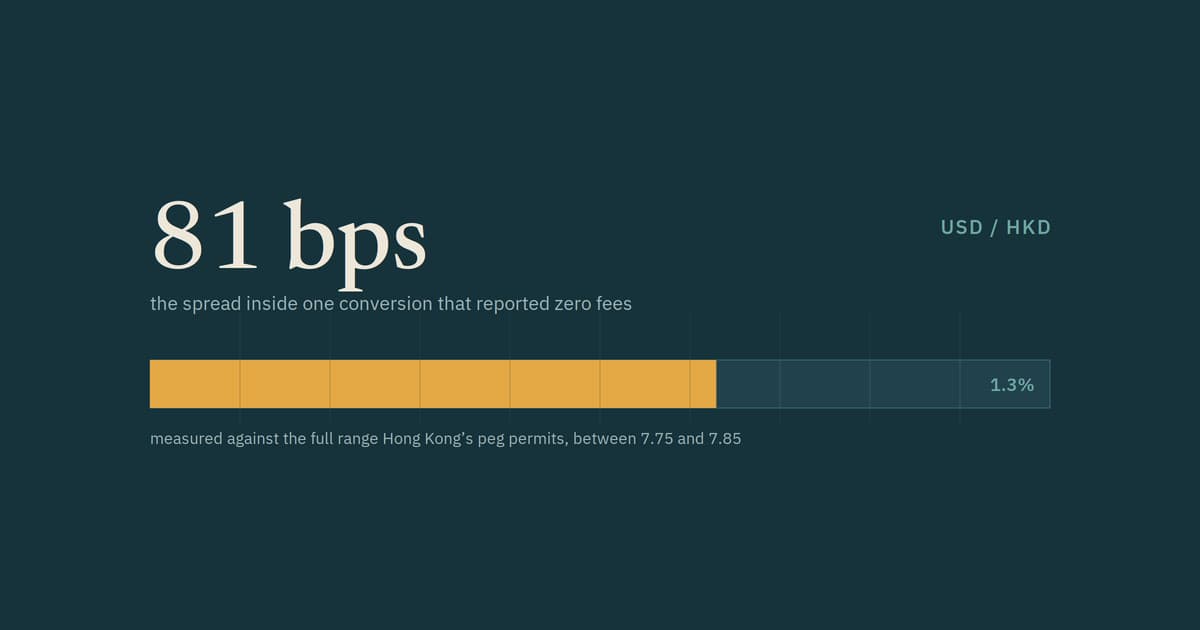
Author: Jett Fu, Co-Founder / CEO , Aetheri
Hidden FX tax charges never appear as a number in your books. This spring I moved $23,500 between the currency balances of one business bank account, in three routine transfers. The statement showed zero fees. When I checked the executed rates against an independent daily reference for those three dates, the account had kept $193 of it. That is a spread of 81 to 84 basis points, three times in a row.
The pair was US dollar to Hong Kong dollar. Hong Kong runs a linked exchange rate system with convertibility undertakings at 7.75 and 7.85 to the dollar, so the currency is only permitted to move inside a band about 1.3% wide. The bank still priced my conversions roughly 0.8% away from mid-market. That single spread consumed close to two thirds of the entire range the currency is legally allowed to travel. If that is the toll on the most predictable pair in the world, consider what your statement is not telling you on dollar-real or dollar-renminbi.
I run a consumer-products company that manufactures in China and sells into US retail, with entities in Hong Kong, the US and Singapore, and new customers in Brazil. There is no treasury department. There is me, at night, with the statements. Every number below is measured from my own accounts or from a live quote I can reproduce.
The Three Drains Behind the Hidden FX Tax
The first drain, and the purest form of the hidden FX tax, is the spread inside the rate. A fee-free conversion carries its cost inside the exchange rate, so the only way to see it is to measure. Take the rate you were given, divide it by an independent reference for the same day, and look at the gap. Scale mine up: a small exporter converting $1 million a year at an 80-basis-point spread hands over $8,000 with no invoice and no line item anywhere. Be generous and assume my three data points caught bad intraday moments. Give back 20 basis points and it is still $6,000 a year for moving numbers between two columns.
The second drain in the hidden FX tax is forced timing. The dollar bought about 6.99 yuan on the first trading day of January and around 6.72 in late August, a slide of roughly 3.9%. My factories bill in renminbi. An exporter who earned dollars in January and converted in August, because that is when the invoices landed, watched China costs rise almost 4% while the supplier changed nothing.
Brazil is wilder. The dollar-real rate opened 2026 above 5.51 and reached the low 4.90s in May, a range of more than 10% inside eight months. Nobody can time this, and I do not try. What hurts is having no choice about the day. When every conversion happens the week a bill is due, you take whatever that week gives, every time.
The last part of the hidden FX tax hides in the corporate structure. Revenue lands in a US entity in dollars. The manufacturing bill gets paid from an Asian entity. Money that hops between entities and changes currency on the way pays the spread again, so two hops with a conversion each is the same hidden FX tax collected twice on the same margin. No accounting line captures it. The margin is simply thinner than the spreadsheet said.
Fintechbits analysis
Why a Pegged Currency Exposes the Hidden FX Tax
The Hong Kong number is worth sitting with, because a peg removes the usual excuse. Banks justify wide spreads on volatility and risk. There is very little of either inside a 1.3% band defended by a monetary authority with the reserves to defend it.
So the hidden FX tax on that pair is not compensation for risk. It is a price set because nobody checks. That is the useful thing about starting your measurement on the most boring pair you trade: whatever spread you find there is close to a floor, and everything else you convert is priced worse.
Four Fixes That Remove the Hidden FX Tax
The fix that removed most of the hidden FX tax cost nothing: stop converting. A multi-currency account holds dollars as dollars and renminbi as renminbi. Revenue now stays in the currency it arrived in until a bill in another currency requires a conversion. Most of my flows never convert at all anymore. The money that must change currency does it once, on purpose. The cheapest conversion is the one that never happens, and until I could hold several currencies side by side I could not see which conversions were unnecessary.
The second fix was making the price visible. Conversions that must happen now run through rails executing at the interbank mid with the fee shown as a separate line. As I write, the same $7,500 dollar-to-Hong-Kong-dollar conversion my bank did at an invisible 0.8% quotes 0.42% all-in on such a platform, fee stated in dollars, mid-market rate beside it. A $45,000 transfer to Brazilian reais quotes 0.83%. Seven thousand dollars to renminbi quotes 0.98%. Whether those prices are cheap is almost beside the point. They are legible, and a visible number can be compared and negotiated. A rate that answers to nothing cannot.
Then I took back the calendar, which is where the hidden FX tax compounds quietly. Holding both sides of a pair means conversions happen on a schedule I set, in planned amounts, rather than urgent lots in invoice week. I still cannot predict rates. I no longer have to accept their worst moments.
The quietest fix against the hidden FX tax was contractual. Where the relationship allowed, we matched the invoicing currency to the currency my revenue already arrives in, and priced the difference explicitly instead of letting it hide in the rate. A supplier who invoices in your revenue currency has taken the conversion off your books entirely. That is worth a real conversation at renewal, and it costs one sentence to raise.
One thing did not help: hedging products. Forwards and options are real instruments, priced for treasury desks with volume and credit lines behind them. At my size the pricing on the hedge ate most of the risk it removed. Below eight figures of annual flow, my experience is that the four fixes above remove the bulk of the hidden FX tax, and the derivative mostly removes your attention. Someone with different volumes may reasonably conclude otherwise.
Why the Hidden FX Tax Survives in Plain Sight
The hidden FX tax persists because it never appears as a number anywhere in your books. Measure it once against an independent reference and it stops being invisible. Hold your currencies instead of reflexively converting them and most of it stops being paid.
None of this is exotic treasury work. It is cost visibility applied to a line item that was never printed, and it is available to any smaller exporter willing to spend an evening with a statement and a reference rate. The small exporters I know do not lose this money because it is unavoidable. They lose it because the statement says the fee was zero, and nobody argues with a zero.
Jett Fu runs a cross-border consumer-products business that manufactures in China and sells into US retail, and personally manages its treasury across Hong Kong, the US and Singapore.
Fintechbits covers cross-border payments, business banking and treasury operations. Nothing here constitutes financial or investment advice. All analysis represents the editorial views of Fintechbits.