5 mins read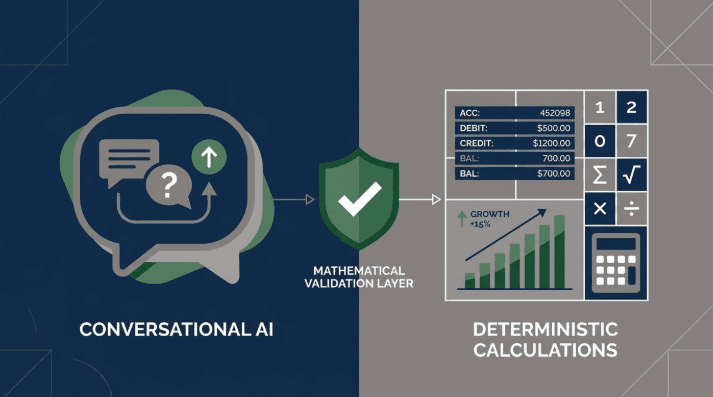
Agentic payments arrived in 2026, and artificial intelligence quietly crossed a critical line. It stopped just talking about money and started moving it.
Almost overnight, the agentic payments infrastructure letting machines spend on our behalf went from experimental tech demos to active production. Stripe and OpenAI launched an agentic checkout protocol allowing ChatGPT to complete purchases. Visa wired its rails into the OpenAI assistant, and Mastercard built out Agent Pay for autonomous AI agents.
But there is a deeply uncomfortable reality underneath this beautiful plumbing. In the exact same window that we built the pipes for AI to spend our money, the evidence showing we cannot trust them to manage it grew significantly.
The Evidence Arrived Alongside the Agentic Payments Rails
This summer, researchers at Stanford and MIT showed how volatile AI financial guidance can be. Simply phrasing an identical financial question the way a woman might ask it returned projected retirement wealth roughly $60,000 lower. Separately, when questions used less financially literate language, simulated savers ended up close to $50,000 poorer. Same underlying circumstances, wildly different answers based on who the model thought it was talking to.
Meanwhile, Kiplinger sat leading chatbots down with real-world scenarios and caught one confidently citing a tax rule that does not exist.
Yet consumers are climbing in anyway. NerdWallet data shows that 26 percent of people have already used a chatbot for personal finance, and among those who acted on that advice, 29 percent reported direct financial harm. Adoption of agentic payments is running years ahead of trust, and that lag is where the financial damage begins to compound.
The Failure Mode That Agentic Payments Make Dangerous
As a builder of a financial planning platform, the failure that keeps me up at night is not the obvious, wild hallucination that a human would instantly spot. It is the error that looks completely, beautifully correct.
I see it constantly. A financial plan comes back perfectly formatted, the numbers reconcile, and the columns add up. Yet the plan is fundamentally impossible, because it quietly breaks an unbreakable rule of household finance. It might leave a substantial pool of a user’s cash idle earning zero interest while they carry expensive, high-interest debt. It passes every surface test a developer would typically write. Flawless on top, economically broken underneath. That is the failure agentic payments turn into a transaction.
When AI was limited to a conversational advisory role, a bad suggestion was just an annoying paragraph you could catch and ignore. The human reading the screen was the safety net. Once agentic payments let AI act, that safety net disappears.
An autonomous agent does not have financial intuition. It does not pause because a strategy feels wrong. It simply executes. The gap between looking correct and being correct becomes the entire risk of the category.
What Agentic Payments Need Underneath Them
The fix is not less AI. The anti-AI stance is both lazy and wrong. AI is brilliant at drawing a person out, translating messy life situations into structured goals, and explaining complex concepts without jargon.
But AI is not there yet to articulate the user’s scenario, the inputs and the math all at once. Agentic payments raise the cost of that limitation sharply.
The fix is a clean separation of concerns. The model belongs at the door, handling the conversation and explaining insights. A deterministic calculation engine belongs at the desk, running the exact same way for everyone, every time. On top of that, we must build a verification layer, a silent and unbreakable gatekeeper that stress-tests every plan against real-world economic rules before it is authorized to move a single dollar.
Correctness Is the Real Test for Agentic Payments
Correctness in agentic payments is about far more than cleverness. For the first time, the answer from a machine does not stop at your screen. It moves your money.
We taught AI to spend before we taught it to be right. The work of the next few years will be about closing that gap. Not by building better-sounding models, but by anchoring computation in mathematical truth and refusing to act until the math is verified.
Before you let any machine spend on your behalf, make it show you the math and confirm the inputs hold.
For related reading, our guide to AI in fintech tracks adoption across financial services. Our analysis of the future of payments covers the rails behind agentic checkout, while our piece on retail investing support examines the advice and suitability questions raised here. The Stanford Graduate School of Business summarised the research on AI financial advice. NerdWallet published the consumer survey data, and Stripe documents the Agentic Commerce Protocol.
Vignesh Coumarane is the founder of InvestEd, an education-first financial planning tool that draws out user inputs, runs math deterministically, and verifies the logical validity of every plan before it is executed.
Fintechbits covers AI in financial services, agentic commerce and financial planning technology. Nothing here constitutes financial or investment advice. All analysis represents the editorial views of the author.