15 mins read
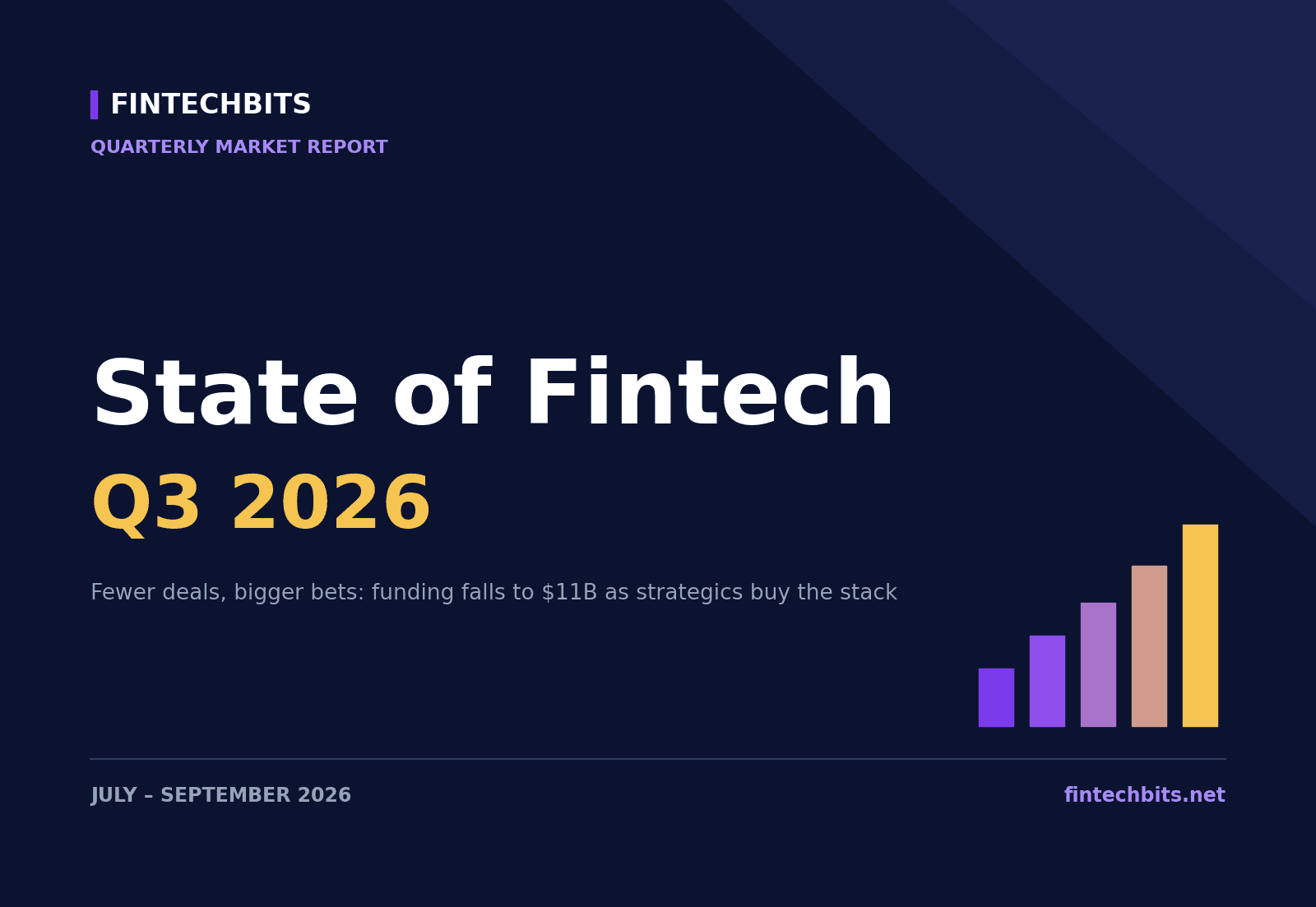
Fintech startups raised roughly $11 billion in the third quarter of 2026, according to CB Insights, an 18% drop from the second quarter and the smallest quarterly total since Q3 2024. Deal count fell to 650, down 46% year on year and the lowest in more than four years. Fintechbits’ tally of the six largest fintech acquisitions signed in Q3 2026 comes to about $22.3 billion in disclosed or reported value, roughly double the $11 billion venture investors put into fintech startups over the same three months. On the venture numbers alone, Q3 reads like a market losing its nerve.
It wasn’t. The same quarter produced nine new fintech unicorns, the joint highest quarterly tally since 2022, a $53 billion takeover bid for PayPal, Stripe’s largest acquisition ever, and Vanguard writing a multibillion-dollar cheque to get into RIA custody. The central tension of Q3 is simple: capital is not leaving fintech, it is concentrating. Fewer companies are getting funded, the ones that do are getting bigger cheques, and the most consequential money of the quarter came from strategic buyers rather than venture funds.
Q3 2026 fintech funding: a third straight decline, with a fat tail
Global fintech funding fell for a third consecutive quarter in 2026, according to CB Insights: $14.5 billion in Q1, $13.3 billion in Q2 and $11.0 billion in Q3. The market is on pace for about $52 billion for the year, down 14% from 2025, extending the slowdown we flagged in our State of Fintech Q2 2026 report. Dealroom’s $11.9 billion for the quarter points the same way. FinTech Global, using a much broader definition, counts $27.5 billion, but we lean on the narrower venture view because it better reflects how hard it is for an ordinary founder to raise.
The more important number is the split. Rounds of $100 million or more made up just 4% of deals but 61% of all dollars in Q3, up from 46% a year earlier. That works out to roughly $6.7 billion flowing into a couple of dozen mega-rounds, and about $4.3 billion spread across everything else. The median deal rose 19% to $5.0 million. Investors are not spreading smaller cheques wider; they are writing fewer of them and backing companies they think have already won. Nearly half of all deals went to US companies, the highest share in over four years, while Asia raised $3.2 billion, almost triple Europe.
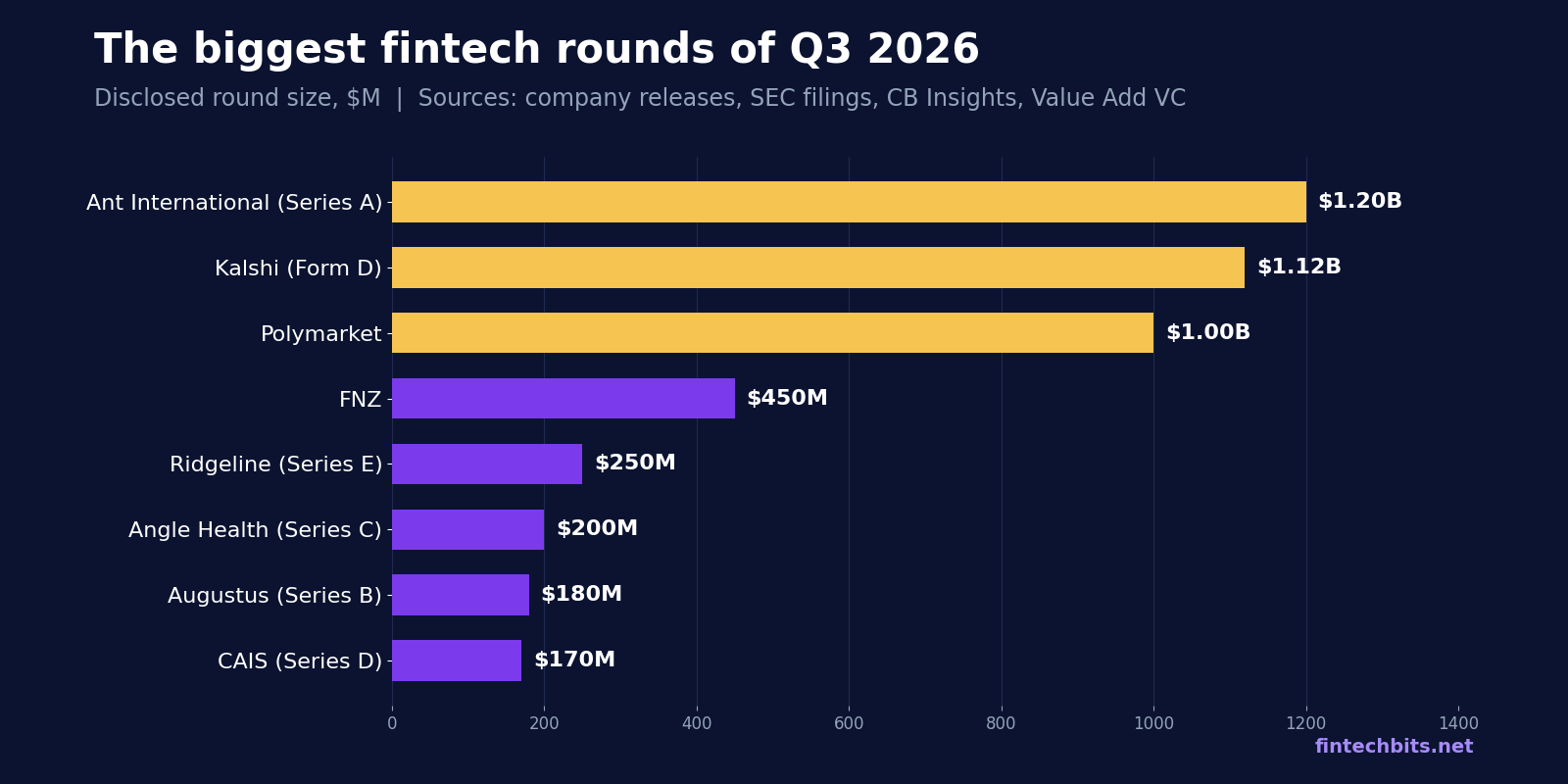
The largest rounds of the quarter:
- Ant International, $1.2 billion Series A (July). Ant Group and Alibaba took part. Reuters reported a pre-round valuation of about $10 billion.
- Kalshi, $1.12 billion (SEC Form D, August). Sold against a $1.5 billion target, with no lead or valuation disclosed.
- Polymarket, $1 billion (August). Led by 1789 Capital at a reported $21 billion post-money valuation, up from $15 billion in April.
- FNZ, $450 million (September). From existing backers including La Caisse, CPP Investments and Motive Partners, to fund the wealth platform’s turnaround.
- Ridgeline, $250 million Series E (September). Led by founder Dave Duffield at a $1.425 billion valuation.
- Angle Health, $200 million Series C (September). Led by Vitruvian Partners at a $2.7 billion valuation, bundled with a $400 million employee tender.
- Augustus, $180 million Series B (July). Tiger Global led the round in the global dollar bank at a $1 billion valuation.
- CAIS, $170 million Series D (July). Vista Equity Partners led, valuing the alternatives platform above $2 billion.
Two of the top three are prediction markets. Heading into the US midterms, venture capital has decided event contracts are fintech’s hottest category, a bet on regulatory tolerance as much as unit economics.
Q3 2026 fintech M&A: strategics did the heavy lifting
If venture money was cautious, corporate buyers were not. CB Insights counts 230 fintech M&A deals in Q3, down 32% year on year, but Windsor Drake tallied $66.8 billion of disclosed consideration and found 86 of the 88 deals it tracked were done by strategic acquirers.
The headline was Stripe and Advent International’s $60.50-a-share, roughly $53 billion offer for PayPal on July 15, the largest deal ever proposed in the sector. PayPal’s board reportedly held out for more, and Bloomberg reported on August 28 that the consortium had walked. PayPal fell almost 13% that day, closing below the bid. Strip it out and disclosed Q3 value drops to about $13.8 billion, a normal quarter.
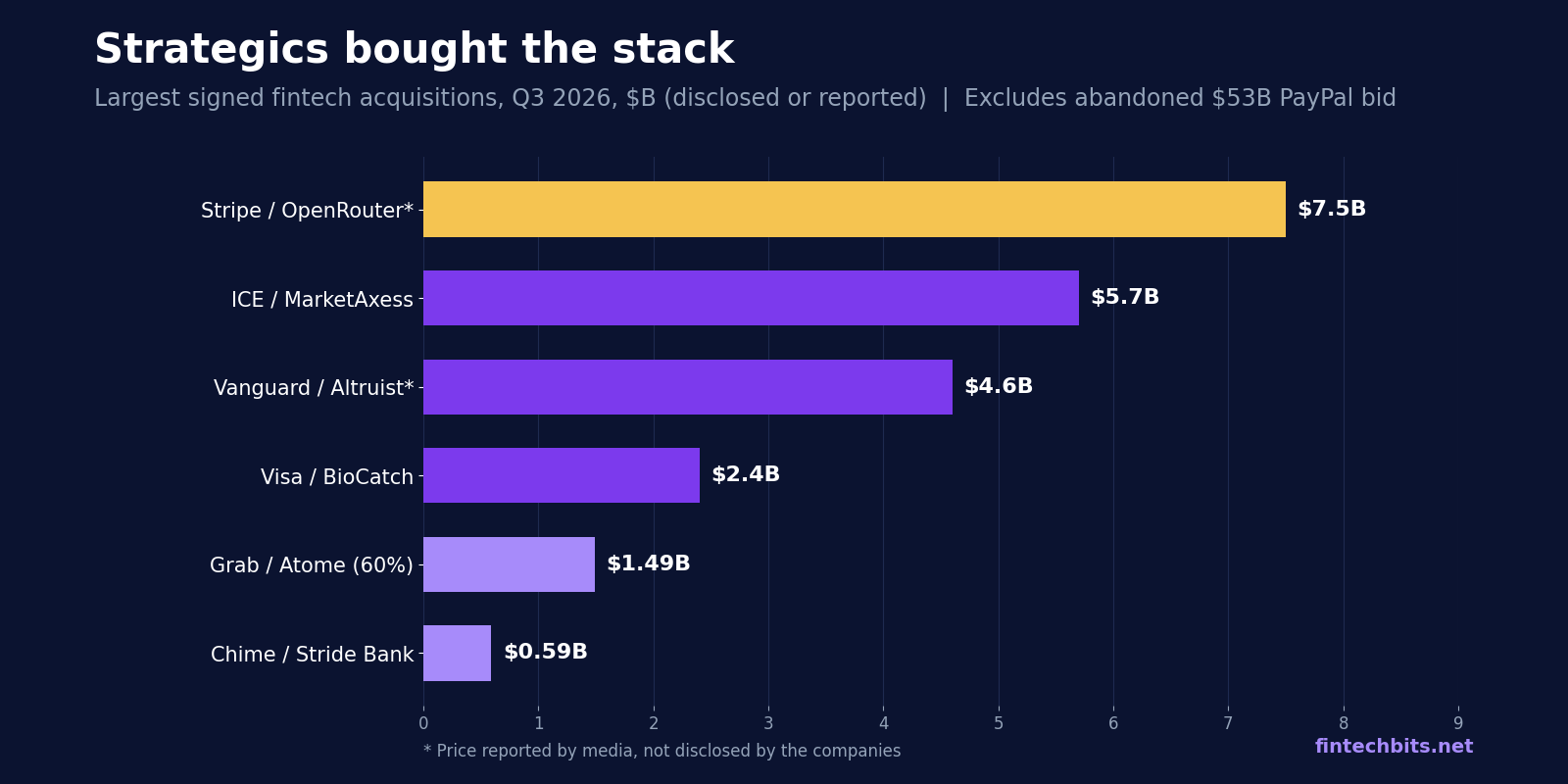
Normal, but revealing. The deals that did get signed were capability grabs:
- Stripe agreed to acquire OpenRouter in August, its largest acquisition to date. Terms were not disclosed, with reports ranging from over $7 billion (Bloomberg) to $7.5 billion (New York Times). Stripe is buying the routing layer that enterprises use to pick and pay for AI models.
- ICE agreed to buy MarketAxess for $5.7 billion in cash, deepening its fixed income electronic trading franchise.
- Vanguard agreed to acquire Altruist, the custodian for independent advisers. Axios reported $4.6 billion in cash, more than double Altruist’s last private mark of $1.9 billion. CB Insights calls it the largest fintech M&A exit of the quarter.
- Visa agreed to buy BioCatch for $2.4 billion in cash, adding behavioural biometrics to its fraud stack.
- Grab agreed to take 60% of BNPL provider Atome Financial for $1.49 billion, with a formula-priced option on the remaining 40%.
- Chime agreed to buy Stride Bank, its long-time partner bank, for $590 million in cash, about 1.5 times tangible book.
Look at the buyers: a payments processor buying AI infrastructure, an asset manager buying a custodian, a card network buying fraud tech, a neobank buying a bank. Every one of them is paying to own a layer of the stack it used to rent.
The deep dive: fintech is buying its own plumbing
Vertical integration is the theme that connects fintech’s Q3 2026 deals. For a decade the neobank model rested on renting a sponsor bank’s charter. Chime now says owning one is the faster route to full-stack control, and expects more than $100 million in net synergies. TabaPay’s planned purchase of Transact Bank, announced alongside its $155 million raise, makes the same argument from the payments side.
Stripe’s OpenRouter deal is the more ambitious version. Stripe already bought usage-billing specialist Metronome earlier this year. Adding OpenRouter puts it on both sides of the AI transaction: billing the model providers and routing the enterprises that consume them. If AI agents become meaningful buyers of software and services, Stripe wants to own the meter, the router and the checkout.
Regulation is pushing the same way. The GENIUS Act machinery finally moved: the Federal Reserve proposed issuer rules on September 24, including a ban on paying yield simply for holding a stablecoin, and Treasury issued an interim final rule on September 30 for certifying state regimes, with $10 billion of issuance as the line above which issuers move to federal oversight. Licensing bites from January 18, 2027. Issuing a dollar token is becoming a regulated banking activity, and owning the regulated layer is becoming the moat.
Fintech IPO watch: a quiet Q3, a loud pipeline
Q3 2026 was thin for fintech listings. Renaissance Capital counted just seven US IPOs of any kind in September, and the financials that priced were an insurer and a savings bank, not venture-backed fintechs. The wider market is fine: Renaissance says 2026 proceeds are already a record, driven by mega listings outside fintech.
The pipeline is busier. Ant International’s raise is aimed at a Hong Kong listing, and Ant-backed GCash parent Mynt debuted in Manila on October 20 after the Philippines’ largest IPO. OPay filed for an estimated $500 million US IPO on October 9, and Plaid was reported in July to be talking to banks. Kraken now reportedly targets Q2 2027 at the earliest, Kalshi has ruled out 2026, and Revolut, valued at $115 billion in a July secondary, says no earlier than 2028. Our view: the window is open for scaled, profitable fintechs. Most of them are choosing to stay private because private capital still pays up.
The other side of the ledger: fintech layoffs in Q3 2026
Fintech’s funding concentration in Q3 2026 showed up in headcount. Trustly confirmed about 200 job cuts in September, and Klarna trimmed roughly 100 more roles after cutting around 750 in May. Neo Financial, Mambu, Bluevine and Bitcoin Suisse all announced reductions the same month, and ADP data showed financial activities employers shed 16,000 jobs in September. Part of this is the squeeze on mid-stage companies outside the mega-round club. Part of it is AI, with lenders and payments firms openly using automation to run operations, support and compliance with fewer people.
Q3 2026 fintech activity by vertical
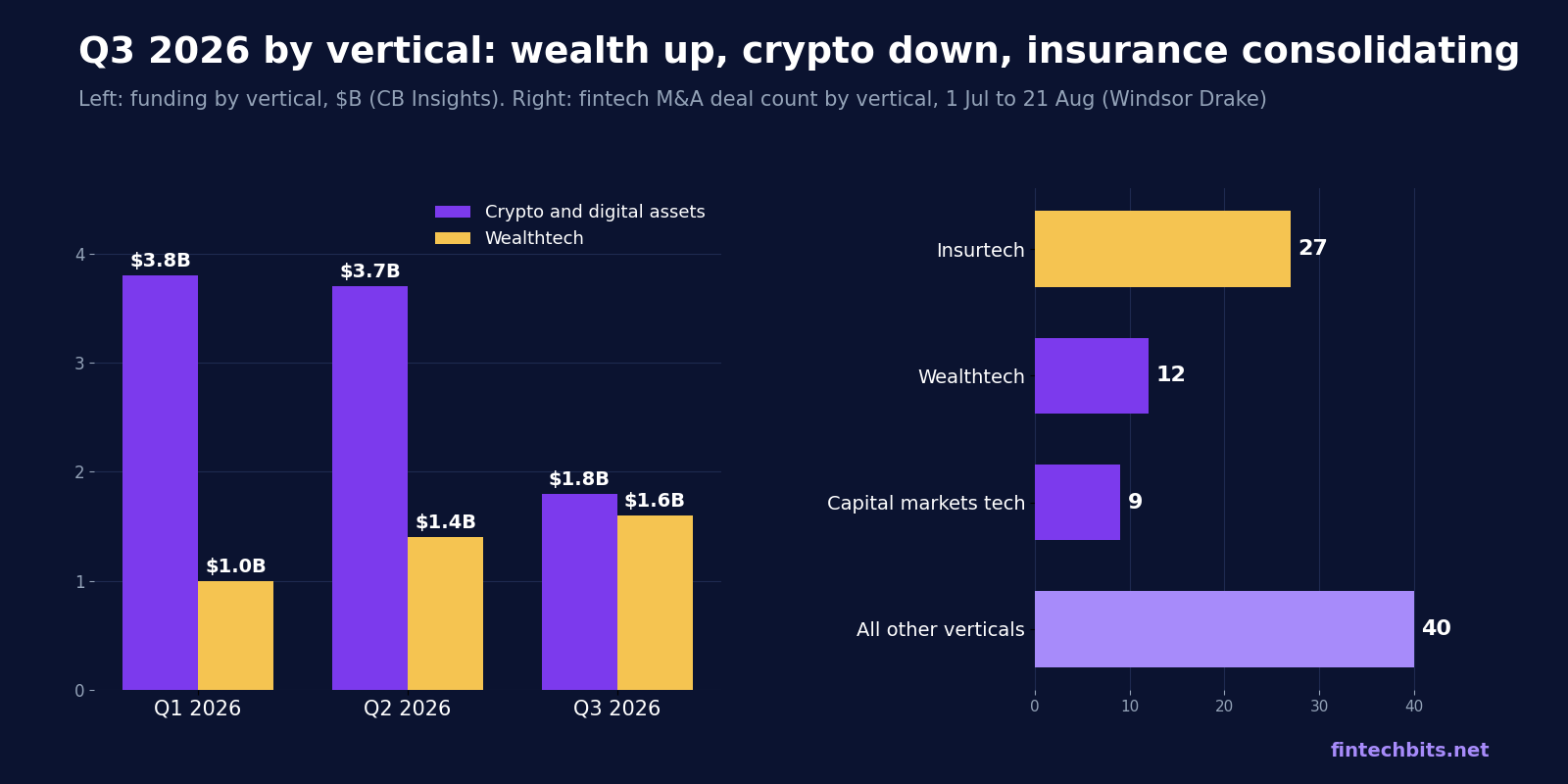
Fintech activity in Q3 2026 split sharply by vertical: wealthtech funding rose for a third straight quarter, crypto funding halved, and insurance led the M&A count. The table below pulls together funding and deal activity for each major vertical, followed by our read on each.
| Vertical | Q3 2026 funding signal | Q3 2026 M&A signal | Defining deals |
|---|---|---|---|
| Payments and infrastructure | Ant International’s $1.2B Series A was the quarter’s largest round | Led all verticals on disclosed M&A value (Windsor Drake) | Stripe and OpenRouter, Visa and BioCatch ($2.4B), Francisco Partners and Moneris (about C$2.0B) |
| Digital banking and neobanks | Augustus raised $180M at $1B; Revolut set a $115B secondary mark | Fintechs buying charters rather than renting them | Chime and Stride Bank ($590M), TabaPay and Transact Bank |
| Lending and BNPL | Few large equity rounds; UK BNPL regulation live from July 15 | Superapps and banks buying credit books | Grab and Atome (60% for $1.49B), Valley National and Bluevine ($340M) |
| Wealthtech | $1.6B, up from $1.4B in Q2 and $1.0B in Q1 (CB Insights) | 12 deals, second only to insurtech (Windsor Drake) | Vanguard and Altruist, FNZ ($450M), Ridgeline ($250M), CAIS ($170M) |
| Insurtech | AI firms took 99.1% of insurtech funding in Q2 (Gallagher Re); Q3 data due | 27 deals, about 31% of all fintech M&A (Windsor Drake) | Munich Re and At-Bay ($575M), Angle Health ($200M at $2.7B) |
| Crypto, stablecoins and prediction markets | Crypto funding $1.8B, down from $3.7B in Q2, about 16% of fintech dollars (CB Insights) | Limited; regulation dominated | Kalshi ($1.12B per Form D), Polymarket ($1B at $21B), GENIUS Act proposals |
| Capital markets tech | Texas Stock Exchange parent TXSE Group raised $155M | 9 deals (Windsor Drake) | ICE and MarketAxess ($5.7B) |
Payments. Payments infrastructure was where the biggest cheques landed on both sides of the market. Windsor Drake found payments led fintech M&A on value, with incumbents buying capabilities around the transaction: fraud, routing and processing. Visa’s data processing revenue growing faster than its payments volume, which Windsor Drake highlights, explains why.
Digital banking. The neobank story in Q3 2026 was about ownership rather than growth rounds. Chime buying Stride and TabaPay buying Transact Bank show the sponsor-bank model giving way to owned charters, while Revolut’s $115 billion secondary shows the top of the category is still being priced like a platform.
Lending and BNPL. The UK brought buy now, pay later under FCA regulation from July 15, with affordability checks and Financial Ombudsman access, and the EU’s revised Consumer Credit Directive applies from November 20. In Asia, Grab’s Atome deal shows superapps would rather own consumer credit than partner for it.
Wealthtech. Wealthtech was the strongest vertical of Q3 2026 and the only one CB Insights shows rising every quarter this year, with $4.1 billion raised through September. FinTech Global’s broader count is $2.8 billion across 124 deals. Add Vanguard and Altruist, and wealth infrastructure had its best quarter in years.
Insurtech. Insurance was the busiest vertical for fintech M&A by count, as brokers and carriers rolled up distribution and specialist underwriters. Munich Re’s $575 million purchase of cyber insurer At-Bay was the standout, and Angle Health’s $2.7 billion valuation shows growth investors still pay for health insurance distribution with real revenue.
Crypto and prediction markets. Crypto funding fell to $1.8 billion in Q3 2026, roughly half the Q2 level, even as prediction markets took two of the quarter’s three largest rounds. Money moved from tokens and exchanges toward regulated event contracts and stablecoin infrastructure that can survive the GENIUS Act rulebook.
AI across verticals. No major tracker has published a clean AI share of Q3 fintech funding yet, and we will not invent one. The signal is still loud: agentic payments startups Sapiom and Natural raised Series A rounds, and the quarter’s largest signed acquisition is an AI infrastructure bet.
Frequently asked questions
How much did fintech startups raise in Q3 2026?
Fintech startups raised about $11 billion globally in Q3 2026 across 650 deals, according to CB Insights, down 18% from Q2 2026 and the lowest quarterly total since Q3 2024. Dealroom puts Q3 2026 fintech venture funding at $11.9 billion, while FinTech Global’s broader definition counts $27.5 billion.
What was the biggest fintech deal in Q3 2026?
The largest proposed fintech deal of Q3 2026 was Stripe and Advent International’s roughly $53 billion offer for PayPal, which the consortium abandoned in late August. Among signed deals, Stripe’s agreement to acquire OpenRouter, reported at $7 billion to $7.5 billion, was the largest, followed by ICE’s $5.7 billion purchase of MarketAxess.
What does the state of fintech Q3 2026 data say about where capital is going?
The state of fintech in Q3 2026 is concentration: $100 million-plus rounds took 61% of venture dollars, per CB Insights. Fintechbits’ tally of the six largest signed acquisitions in Q3 2026 comes to about $22.3 billion, roughly double the $11 billion that went into fintech startups, which shows strategic buyers now set the market’s direction.
Three things to watch in Q4 2026
1. Whether the mega-round machine keeps running. Ramp reportedly raised $1.85 billion at a $60 billion pre-money valuation in mid-October, and Kalshi’s $40 billion round could close any day. If both land, Q4 funding could rebound on the strength of two or three deals while deal count keeps falling.
2. PayPal’s next move. A board that rejected $60.50 a share now has to show it can create more value alone. A revived bid, an activist or a breakup plan are all live possibilities.
3. The stablecoin rulebook. Comment periods run into late November and the OCC is expected to finalise its rule around then. The detail on yield, reserves and foreign issuers will decide who can compete before January 2027.
Q3 2026 was the quarter fintech stopped pretending to be a broad-based venture market. The money is there, but it flows to a narrow set of scaled winners and to incumbents buying the infrastructure they used to rent. We will be back in January with the Q4 edition and a full-year verdict on whether that concentration is healthy consolidation or a warning sign.
Fintechbits analysis
Why this matters
Fintechbits’ tally of the six largest fintech acquisitions signed in Q3 2026, about $22.3 billion, is roughly double the $11 billion venture investors put into fintech startups in the same quarter. Funding fell 18% to its lowest level since Q3 2024 and deal count dropped to 650, yet nine new unicorns were minted and incumbents paid up for AI routing, custody, fraud and bank charters. The open question is whether this concentration is healthy consolidation or a squeeze that leaves too few mid-stage fintechs to buy in 2027.
Methodology: This report covers activity announced between July 1 and September 30, 2026, with selected October developments noted as forward indicators. Funding totals, deal counts, mega-round share, unicorn and M&A counts are from CB Insights’ State of Fintech Q3’26, cross-checked against Dealroom and FinTech Global. M&A values draw on Windsor Drake’s Q3 2026 Fintech M&A report, company announcements, Bloomberg, Axios, the New York Times and FinTech Futures. Individual rounds are from company releases, SEC filings, Value Add VC, Crunchbase News and FinTech Global. IPO data is from Renaissance Capital and company disclosures. Stablecoin rulemaking is from Federal Reserve and Treasury releases and law firm analysis. Workforce data is from FinTech Futures, TrueUp and ADP. Reported deal values not confirmed by the companies are labelled as reported. Trackers use different definitions of fintech, so totals from different sources are not directly comparable.