8 mins read
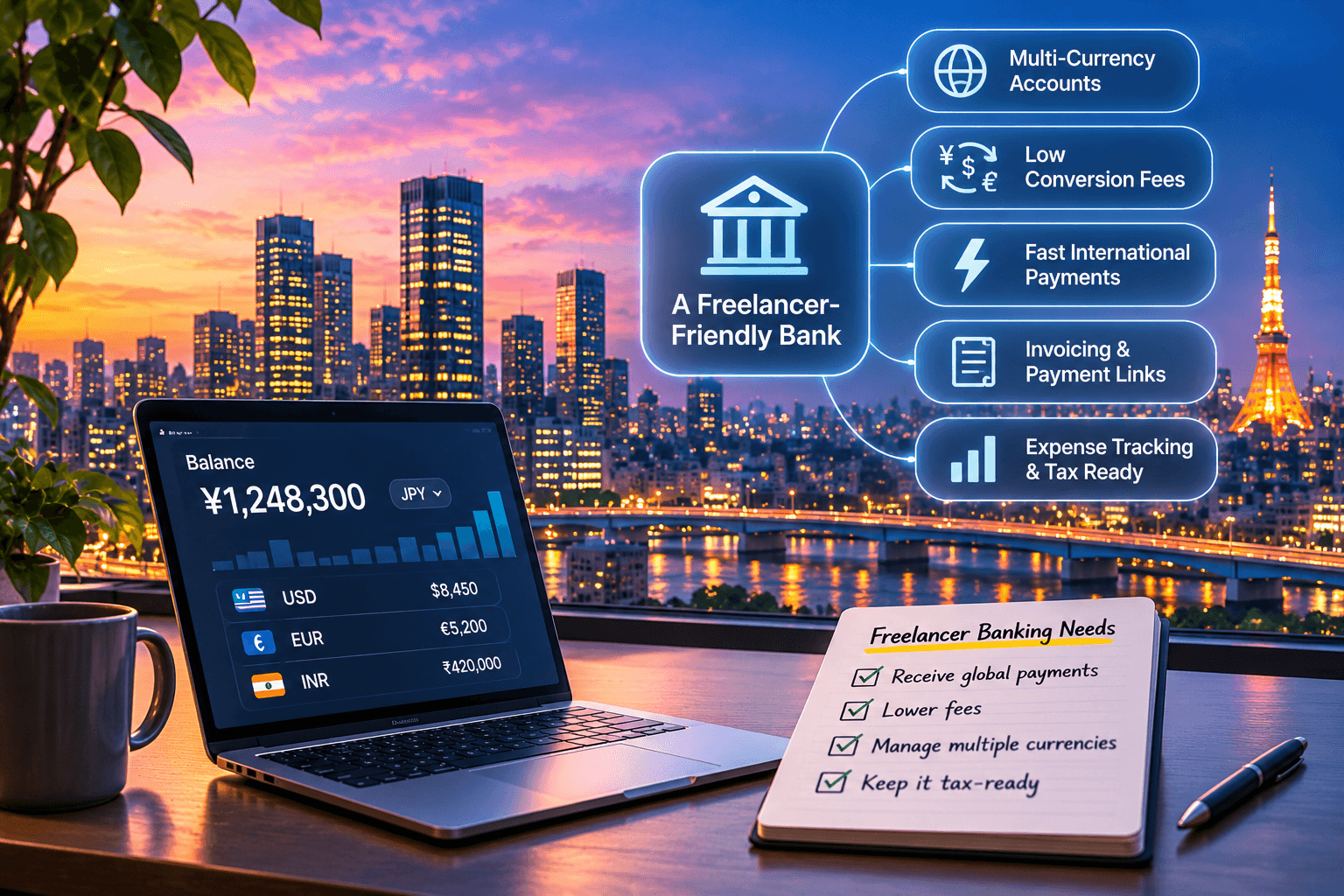
Freelancers are paid in uneven lumps, owe tax later and must prove income without payslips. Three respondents explain what freelancer banking should do that traditional accounts still do not.
Freelancer banking has grown into its own market, but many independent workers still run their business through a standard current account. Their income arrives in uneven lumps, tax falls due months later and lenders expect payslips they do not have. Meanwhile, a record 74.9 million Americans worked independently in 2026, MBO Partners found. As a result, freelancer banking matters to more people every year. Many specialist accounts run on partner banks, as our explainer on banking-as-a-service describes.
We asked one question: what do freelancers and gig workers need from a financial provider that traditional banks still fail to offer? The brief sought founders and product leads at freelancer banking, invoicing and tax platforms, plus freelancers with strong views. First-hand experience mattered more than general advice. Three people answered in this round, and we used all three. None works at a freelancer banking platform, though two write as freelancers and contractors, so we’ve set their views against the tax rules shaping this market.
Fintechbits analysis
Why freelancer banking matters more now
Tax rules are raising the stakes for freelancer banking. In the UK, Making Tax Digital for Income Tax began on 6 April 2026, GOV.UK confirms. It covers sole traders and landlords with qualifying income over £50,000. The threshold falls to £30,000 in April 2027 and £20,000 in April 2028. So many more freelancers will need digital records, which puts pressure on freelancer banking apps to link payments to tax.
The US has moved the other way on reporting. The One Big Beautiful Bill restored the old Form 1099-K threshold, the IRS says. Payment apps now report only above $20,000 and 200 transactions. Also, the threshold for Forms 1099-NEC and 1099-MISC rises from $600 to $2,000 from 2026, Littler notes. However, fewer forms do not mean less tax, so freelancer banking tools that track income matter more.
Tag every payment to a project
John Mac founded Exit Evidence, which helps Shopify founders prepare to sell, and has worked as a contractor hiring other developers.
“Think about a freelancer who invoices $100,000 and keeps $35,000 as gross margin. When he looks at his bank account, he sees the $100,000 come in and the payments out as inconspicuous line items. We need a bank account for freelancers and contractors that recognises this.
I’ve worked on many projects where I hire smaller product developers as 1099 contractors. Clients pay me by milestone, and I pay those contractors by milestone in turn. When I look at my bank account, I see money go in and out. That doesn’t tell me how much of a $25,000 deposit will go out for that project. A freelancer needs to know that a $7,500 contractor payment and a $2,000 software bill belong to project A’s milestone. The bank account doesn’t know that.
A purpose-built bank account would let him attribute deposits and withdrawals to a project. When the $25,000 deposit comes in, he knows that $7,500 is for contractors, $2,000 is for software and $2,500 is for taxes. He knows that the rest is his.
He needs an easy way to do this, whether in a mobile app or when he uses his debit card. If you ask him to go back and do it for every transaction, he never will. My own bank labels my political donations as insurance payments. If I could easily reassign those, I would.
This is what will build loyalty. You’ve given him a meaningful way to know how much he has earned, so he can negotiate his partners’ payments accordingly.”
[John Mac](LINKEDIN URL NEEDED), Founder, Exit Evidence
His answer is the most concrete here. A freelancer who passes money on to subcontractors sees large sums arrive that are mostly not theirs. Tagging each deposit and payment to a project shows the real margin, which freelancer banking can do and a standard current account rarely does. His point about tagging at the moment of payment matters too, since few people fix their records afterwards.
However, the figures in his original answer did not add up, so we’ve made his example consistent. We also removed a reference to a specific political party. His contractors are paid as 1099 workers, a US arrangement. Since the higher $2,000 threshold means fewer forms, tracking payments inside the account becomes more useful, not less.
Separate tax as money arrives
Ankit Sarawagi curates CFO Matrix, a finance resource, and writes here as a freelancer.
“Banks rely on regular income, but freelancers may not get deposits every week, because they can be random. We also don’t know how much tax we owe.
Many freelancers fall into the same trap: spending all their money one month and then having none left to pay tax the next. It would help to have an account that automatically separates money into two pots, one for spending and one for tax. You can decide the ratio with your accountant.
Then there’s proof of income. Even if you are a reliable freelancer with regular income, it can be hard to prove when applying for a loan, because the bank wants to see payslips. I don’t know which type of freelancer would change banks.”
Ankit Sarawagi, Curator, CFO Matrix
His tax pot is the simplest fix on this list. If a fixed share of each payment moves aside automatically, the freelancer cannot spend money owed to the tax office. In addition, the UK’s move to digital tax records makes that habit more valuable, and it is an easy feature for freelancer banking providers to offer.
His point on proof of income is the harder problem for freelancer banking. A freelancer with steady earnings can still struggle to borrow because lenders look for payslips. Bank data could help, since open banking lets a lender see real transactions with the customer’s permission, as our explainer on open banking shows. We softened his original wording, which blamed freelancers’ tax problems on being irresponsible. His doubt about which freelancers would switch banks is also a fair caution for any provider.
Use the best tool for each job
Abhinav Gupta leads Profitjets, an accounting firm that works with US small businesses.
“Freelancers and gig workers need financial management tools for invoicing, payments and cash flow, much like a business account offers. In my experience as a founder, fintech tools offered more efficient and affordable payment and cash flow reconciliation than our bank did. One lesson from starting and running a business is that, rather than choosing one bank for every financial service, it’s better to pick the best provider for each function. For independent workers, insight into the financial health of the business and the ability to automate payments to themselves go a long way in helping them plan for business expenses.”
[Abhinav Gupta](LINKEDIN URL NEEDED), Founder, Profitjets
His advice runs against the idea of one account for everything. A freelancer might bank with one provider, invoice with another and file tax with a third, as long as the data flows between them. That puts the onus on freelancer banking providers to connect well with other tools. His point about paying yourself automatically also echoes Mac’s project view. Still, he names no providers or figures, and Profitjets is an accounting firm, so this is general guidance rather than product evidence.
What works for freelancer banking
The three answers and the tax rules point to a clear order of work for freelancer banking. First, move a set share of every payment into a tax pot as it arrives, with the ratio agreed with an accountant. Next, let freelancers tag deposits and payments to a project at the point of payment, so the margin on each job is clear. Then connect the account to invoicing and tax software, so records flow without retyping. Finally, give freelancers a way to show steady income from their account history when they apply for credit. Freelancer banking providers that do these four things will close most of the gaps traditional banks leave.
What to watch next
The UK’s April 2027 threshold will bring many more sole traders into digital tax records, testing how well freelancer banking apps link to tax software. Watch whether lenders accept bank transaction data as proof of income more widely. Also watch whether US freelancers keep better records now that fewer 1099 forms arrive.
Above all, freelancer banking works when the account understands the job, not just the balance. Providers that split tax, track projects and prove income will win the freelancers that traditional banks still treat as awkward customers.
FintechBits covers payments, banking and fintech developments for readers in the US and UK. This article is for information only and is not financial or legal advice. Views expressed are those of the FintechBits editorial team.