(Bloomberg) — The United States unveiled new restrictions on China’s access to vital components for chips and AI, intensifying a campaign to contain Beijing’s technological ambitions but falling short of proposals previous decisions that would have sanctioned more key Chinese companies.
Most read on Bloomberg
The Commerce Department imposed new restrictions on the sale of high-bandwidth memory chips made by U.S. and foreign companies, likely affecting South Korean companies SK Hynix Inc. and Samsung Electronics Co. as well as Micron Technology Inc. , based in Idaho. storage and are essential for AI applications.
The agency also expanded existing controls on chipmaking equipment, including products made by U.S. companies in foreign facilities, but with exceptions for key allies, such as Japan and the Netherlands. It comes after months of negotiations between Washington, Tokyo and The Hague, during which Biden officials proposed — but ultimately did not pursue — applying U.S. controls to companies like Tokyo Electron Ltd. and ASML Holding NV.
Shares of U.S. semiconductor equipment companies, including Lam Research Corp., Applied Materials Inc. and KLA Corp., rebounded. In Asia, Tokyo Electron rose as much as 4.8%, while a group of blacklisted Chinese companies, including Naura Technology Group Co., fell. ASML said in a statement that it expects “no direct material impact” on its operations in 2024.
Some analysts have nevertheless warned of uncertain prospects from 2025.
“The United States has taken action and banned the sale of completed HBM chips to China, although this appears to have been largely anticipated,” Andrew Jackson of Ortus Advisors wrote in a note on Smartkarma. “With Trump arriving in January, the jubilation may be short-lived with a more hawkish administration on the horizon. »
The Biden administration’s goal, building on years of evolving trade restrictions, is to slow China’s domestic development of advanced semiconductors and artificial intelligence systems that could help its military. The United States will limit China’s “ability to produce technologies critical to its military modernization or repression of human rights,” the Ministry of Industry and Security’s Bureau of Industry and Security said in a statement. Commerce, which oversees export controls.
China strongly opposed the new restrictions on chips, criticizing the U.S. move as economic coercion that seriously threatened global supply chains. “The United States continues to generalize the concept of national security, abuse export control measures, and use unilateral intimidation,” the Commerce Department said in a statement Monday. “China will take necessary measures to resolutely safeguard its own rights and interests.”
Huawei Suppliers
The new rules blacklisted 140 additional Chinese entities accused of acting on behalf of Beijing, with a focus on companies that produce chipmaking equipment critical to China’s quest toward self-sufficiency in semi -drivers. This includes ASML’s Chinese lithography software rival, Dongfang Jingyuan, which the Dutch equipment giant accuses of stealing its trade secrets.
The sanctions also affect a handful of Huawei Technologies Co.’s suppliers, including equipment maker SiCarrier as well as chipmakers Qingdao Si’En, SwaySure and Shenzhen Pensun Technology Co., or PST.
The rules long in development fall short of previous proposals, Bloomberg News reported last week, sparking widespread rallying among semiconductor supply chain players, from Tokyo Electron in Asia to ASML in Europe. Specifically, the Biden administration chose not to add to the entity list two companies it had previously considered: Shenzhen Pengjin High-Tech Co., which makes semiconductor equipment, and ChangXin Memory Technologies Inc., which is trying to develop AI memory chip technology. .
Asked at a press briefing how many Huawei-related entities the United States knows about and does not add to the entity list, a senior administration official said the rules do not focus on associations with a particular company. According to the official, the list instead includes Chinese companies trying to develop advanced chip capabilities.
Still, regulatory language released Monday cites ties to Huawei as justification for some of the new sanctions. Certain restricted companies “pose a significant risk of contributing to the efforts of Huawei Technologies Co., Ltd., an entity list party, to support the Chinese government’s goal of locally producing “advanced node integrated circuits » to support its military modernization. “, we read in the rule.
Sanctions against Huawei suppliers have been the focus of lobbying efforts by chip tool companies, including Lam, Applied Materials and KLA. These companies have argued for months that U.S. unilateral measures — affecting both individual Chinese chipmaking facilities, as well as the Chinese market as a whole — would harm U.S. industry without comparable measures from allies .
Beyond company-specific sanctions, the controls unveiled Monday impose restrictions on the sale to China of two dozen types of manufacturing equipment and three software tools, including equipment made abroad. This provision uses an authority known as the Foreign Direct Products Rule, or FDPR, which allows Washington to control foreign-made products that use even the smallest amount of American technology.
Allied exclusion
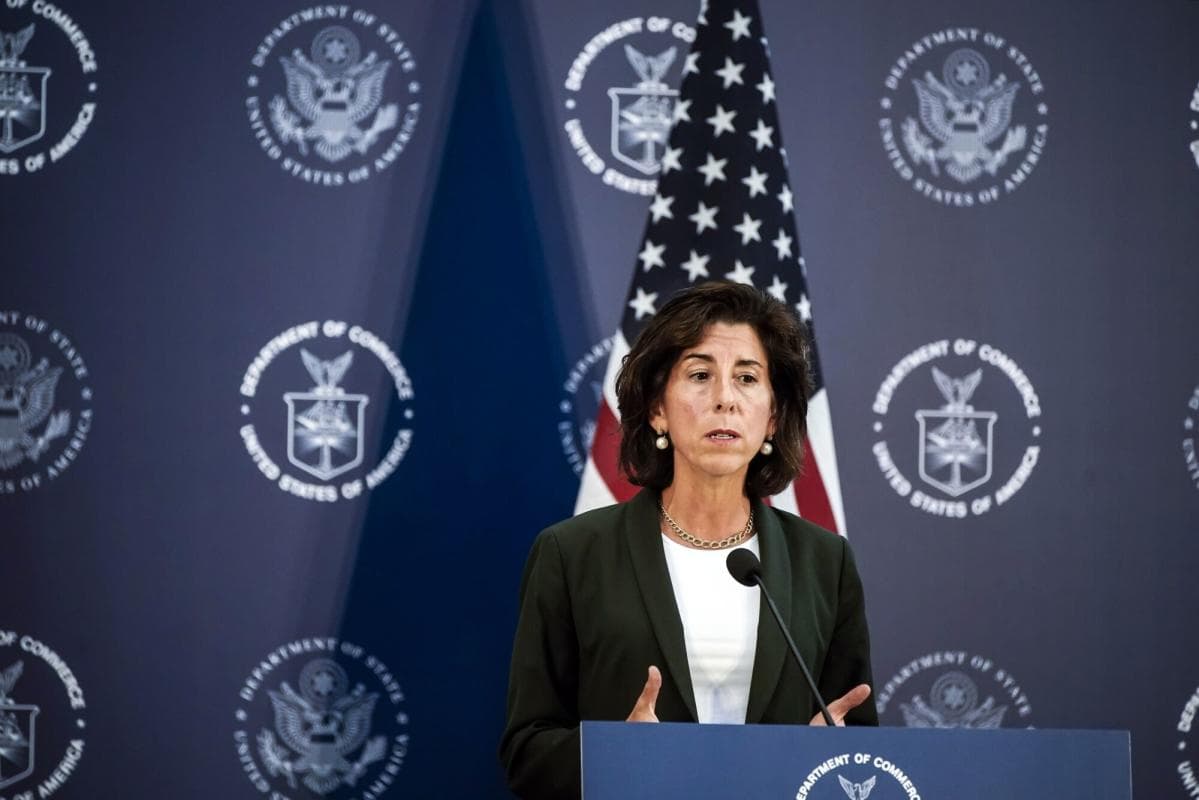
But there is an exemption to the FDPR equipment rules for some countries, including Japan and the Netherlands. The idea, according to a senior administration official, is to create a path for countries capable of imposing comparable controls to adopt such measures themselves. “We need our allies to participate in our controls so that they are as comprehensive and effective as possible,” Commerce Secretary Gina Raimondo said at a press briefing.
ASML said on Monday that if the Dutch government carried out a “safety assessment similar to that underlying the US restrictions” on certain Chinese factories, “exports of DUV immersion lithography systems to these specific locations could also be affected” .
The use of the FDPR, even with exemptions, is intended to prevent U.S. tool manufacturers from avoiding trade restrictions by locating their manufacturing in other countries. A recent report from the Center for Strategic and International Studies, a Washington-based think tank, found that U.S. equipment suppliers have been increasingly exporting products to China from non-U.S. countries since 2016, and especially since 2019.
Memory chips
The new controls also restrict the sale of high-bandwidth memory chips – building on existing restrictions affecting advanced logic chips, which serve as the brains of devices. The memory rules apply to HBM2 and more advanced chips, a senior administration official said, and use the FDPR to police both U.S. and foreign companies. The world leader in supplying HBM chips is South Korea’s SK Hynix, followed by Micron and Samsung.
There are exemptions to this rule, the official said, that allow Western companies to package HBM2 chips in China. These exemptions are limited to packaging activities that pose a low risk of technology diversion to Chinese companies, according to the official.
“This action is the culmination of the Biden-Harris Administration’s targeted approach, in concert with our allies and partners, to hinder the PRC’s ability to indigenize the production of advanced technologies that pose a risk to our security national,” Raimondo said in a statement. .
–With help from Foster Wong and Kurt Schussler.
(Updates with Asian stocks, fourth paragraph comment)
Marvin Evans is a finance and fintech professional with 20 years of industry experience, including more than a decade working across the fintech sector. He is the founder of Fintech Bits and Finjobsly, and writes about fintech markets, financial technology, industry trends, innovation and the evolving fintech workforce. His analysis combines hands-on industry experience with data-led research to provide practical insight into the companies, technologies and trends shaping financial services.
 6 mins read