6 mins read
Author: Sudhanshu Dubey, Enterprise Solutions Architect, Errna
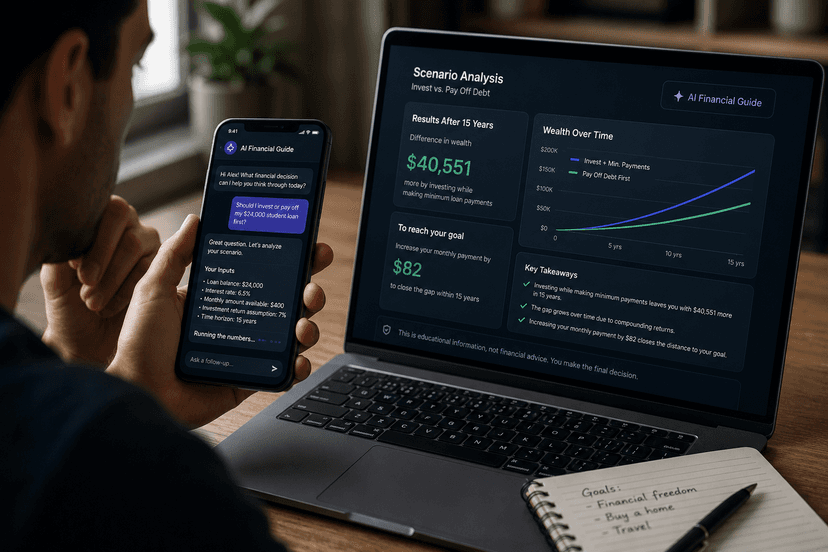
Fintech financial guidance has become the headline promise of nearly every consumer money app. Yet fintech financial guidance that genuinely helps someone make a decision is far harder to build than the polished interface lets on. The gap between the promise on the marketing page and the system behind it is where the real cost hides.
Consumers want a trusted partner to steer them through complex money decisions. Fintechs answered that demand quickly, usually through clean dashboards and friendly nudges. Behind those screens, though, sits a tangle of data pipelines, machine learning models, and compliance obligations that few users ever see. This piece walks through that hidden machinery and the bill that comes with it.
Fintech Financial Guidance Starts With Data Infrastructure
Effective fintech financial guidance rests entirely on data. User interactions, transaction histories, and external market feeds form the bedrock, so a resilient data layer is the first real cost most teams underestimate. Without it, every downstream recommendation inherits the weakness.
That infrastructure has to ingest and process information in real time, handle enormous volumes, and stay secure throughout. Batch processing feels simpler, but it leaves a lag between an event and the advice that should follow it. As a result, the guidance arrives too late to matter, and the user quietly stops trusting it.
Integration makes the problem worse. Legacy core systems, third-party APIs, and clashing data formats rarely line up neatly. Inconsistent data then produces flawed analysis, which is precisely where the original promise of guidance starts to crack. Strong data governance is the only durable fix, and it carries a permanent price tag.
The AI Engine Behind Personalised Advice
Machine learning is what turns raw transaction data into something that feels personal. Recommendation engines suggest relevant actions, while predictive models forecast cash flow gaps or investment outcomes before they happen. Tools like eToro’s AI companion Tori show how far this personalisation has moved in just a few product cycles.
However, a good recommendation engine has to understand spending habits, goals, and risk tolerance, not simply chase popularity. Biased or thin training data can push harmful suggestions, so rigorous data curation never really ends. Models also drift as markets and behaviour shift, which means retraining and validation become a standing operating expense rather than a one-off build.
This is the point where many founders quietly overspend. Industry data already suggests that the money behind AI in fintech is slower and more cautious than the hype implies. Building credible fintech financial guidance on top of that reality demands patience and a realistic engineering budget.
Fintechbits analysis
Why Design Decides Whether Guidance Lands
A brilliant model is useless if the person on the other side cannot understand the output. Clear communication is therefore a feature, not a finishing touch. Financial jargon has to be translated into plain language, and visualisations should make trends digestible rather than intimidating.
Tone matters just as much as clarity. Guidance that sounds judgmental gets ignored, whereas a supportive voice builds the confidence people need to act. Beyond that, every insight should lead to a concrete next step. If the advice suggests an action, the relevant feature ought to sit one tap away, so fintech financial guidance flows straight into doing rather than stalling on a separate screen.
Fintech Financial Guidance Lives or Dies on Trust
Users hand fintechs deeply sensitive information, so trust is the foundation everything else stands on. Transparency about how a recommendation was generated demystifies the model and earns confidence in return. Without that openness, even accurate fintech financial guidance feels like a black box people would rather avoid.
Privacy is the harder half of the equation. European regulators issued roughly 1.2 billion euros in GDPR fines in 2025, and the Digital Operational Resilience Act has applied to financial firms since January 2025. Cumulative GDPR penalties tied to the fintech sector have climbed past several billion dollars, a sobering reminder that weak data handling is now a balance-sheet risk, not a footnote.
Explainability has moved from nice-to-have to regulatory expectation. The American Bar Association notes that robo-advisors face the same fiduciary and transparency duties as human advisers. A feedback loop, where users flag inaccurate advice, both improves the model and signals respect, so the guidance becomes a conversation instead of a verdict.
The Cost of Scaling and Staying Compliant
Growth quietly multiplies every challenge above. As a user base expands, the infrastructure must serve millions of concurrent sessions while keeping models fast and responsive. Cloud-native and microservices architectures help, yet performance monitoring and bottleneck hunting never stop, and that ongoing vigilance is a cost teams routinely forget to forecast.
Compliance scales right alongside the technology. Deploying models at scale demands disciplined MLOps, version control, A/B testing, and automated retraining. On top of that, the line between helpful information and regulated financial advice is thin, and regulators are watching it closely. The SEC has already pursued firms for exaggerating their AI capabilities, a practice now widely called AI-washing. Auditing models for fairness and bias adds yet another recurring line item, so credible fintech financial guidance carries a compliance overhead that simply never goes away.
7 Hidden Costs Behind Fintech Financial Guidance
Pulling the threads together, here are the seven costs that sit beneath the surface of any serious fintech financial guidance feature:
- Data infrastructure. Real-time ingestion, storage, and governance form the foundation, and none of it is cheap to keep healthy.
- Model development. Recommendation and predictive engines need specialist talent and clean, curated training data.
- Continuous retraining. Markets and behaviour drift, so models demand ongoing validation rather than a single launch.
- Experience design. Translating model output into plain, actionable advice takes dedicated design and copywriting effort.
- Privacy and security. GDPR, CCPA, and DORA obligations turn weak data handling into a direct financial liability.
- Explainability. Regulators increasingly expect firms to show how advice is generated, which adds engineering work.
- Scaling and oversight. Infrastructure, MLOps, and fairness audits all grow with the user base and never fully settle.
Governance tools that bake oversight into the workflow, such as the AI controls NetSuite added for finance teams, point toward where the discipline is heading.
A Strategic Imperative, Not a Feature
True guidance asks for far more than an attractive interface. It calls for deep investment in data, mature AI capability, thoughtful design, and a compliance posture that holds up under scrutiny. Trust and transparency are not afterthoughts; they are the pillars the whole structure rests on.
Fintechs that master this complexity can move beyond surface-level assistance and become genuinely indispensable. The ones that treat guidance as a marketing line, meanwhile, will keep paying the hidden costs without earning the loyalty. Real fintech financial guidance is a long-term commitment to operational excellence, and the firms that accept that are the ones users will eventually rely on.
As Sudhanshu Dubey puts it, the true measure of a fintech’s guidance promise lies not in its initial presentation, but in the robust, transparent, and continuously evolving systems that underpin it.
Sudhanshu Dubey is a contributor at Errna.