(Bloomberg) — There is a growing divide in the $530 billion semiconductor industry between companies that are riding the artificial intelligence wave and those that are not. And if we consider the first results of this earnings season, this gap could soon widen into an abyss.
Most read on Bloomberg
“Without AI, the market would be very sad,” Christophe Fouquet, chief executive of ASML Holding NV, said on a conference call last week after the Dutch maker of chip production equipment revised to lowering its sales forecast for 2025 due to weak demand in all areas other than artificial intelligence. AI.
ASML’s results sparked a new round of concern about the health of the chip industry, which is suffering from weakness in key businesses like personal computers and automobiles. It has also been caught up in rising geopolitical tensions between the United States and China, which could cut off access to China’s chip market, which is the world’s largest.
Taiwan Semiconductor Manufacturing Co., which includes Apple Inc. and Nvidia Corp. among its customers, allayed some of those fears after raising its revenue forecast for 2024. Although its growth is fueled by AI-related drivers, overall chip demand has “stabilized.” ” and is starting to improve, said CEO CC Wei.
The Philadelphia Stock Exchange’s semiconductor index, better known by its symbol SOX, fell last week, losing 5.3% on Tuesday alone, before paring its losses following TSMC’s results on Thursday. To highlight this bifurcation, semiconductor equipment makers like ASML and Lam Research Corp. were among the biggest decliners, while several chipmakers, including Marvell Technology Inc., managed to rise.
“We should expect this type of divergence to continue, because it is absolutely correct to assume that it is all about AI,” said Ryuta Makino, research analyst at Gabelli Funds, who believes that separate paths will remain at least until 2025.
Chip designers
The semiconductor industry is often seen as a barometer of the global economy, as chips are vital to a range of products, from data center servers to dishwashers. The companies that provide the equipment needed to create these chips are on the front lines of the industry.
Before semiconductor companies can begin production, it takes months to build, install and test the machines used to make the chips. As a result, companies like ASML take an unusually long-term view of how their customers feel. For now, they are sounding a warning signal for anything other than AI. For example, automotive and industrial OEMs are experiencing lower demand while customers have high inventories.
Additionally, Intel Corp. is cutting costs and delaying construction of new factories as it struggles with falling sales and growing losses. Samsung Electronics Co. apologized to investors this month after delays in developing high-bandwidth memory chips led to disappointing financial results. And investors will be watching Texas Instruments Inc. this week, with earnings due Tuesday, as the company’s analog chips are used by a wide range of customers.
Overall, it appears to be a tough road ahead for equipment makers, many of whom saw their stocks hit record highs earlier this year. Some traders aren’t waiting to see how this plays out and are already dumping stocks.
ASML has just experienced its worst week since early September, with its US-listed share price falling 14%. Applied Materials Inc., the largest U.S. maker of chip equipment, fell 9.1%, while KLA and Lam Research each fell more than 12%.
“We have been more cautious on other semi-equipment names,” Cantor Fitzgerald analyst CJ Muse wrote in a research note. “But I had thought that a longer lead time player like ASML would outperform. It is clear that we were wrong with this assumption.
After ASML’s results, the analyst said he expected the shares to fall further.
Investors will have more information this week when chip equipment maker Lam Research releases its report on October 23. KLA is scheduled to report results on October 30, followed by Applied Materials on November 14.
Increased spending on AI
Things are very different for semiconductor companies which will benefit from big tech’s continued heavy spending on AI development. Microsoft Corp., Alphabet Inc., Amazon.com Inc. and Meta Platforms Inc. pumped in more than $50 billion in capital spending in the second quarter, much of it going to computer component makers. And many of these giants say they plan to spend even more in the coming quarters to expand their AI infrastructures.
Overall AI semiconductor industry sales are expected to climb to $245 billion in 2025, up from an estimated $168 billion this year, according to Solita Marcelli, chief investment officer for the Americas region at UBS Global Wealth Management. She advised customers to look to AI-related chipmakers following ASML’s findings.
“We continue to forecast strong growth prospects for IA semi-trailers and are closely monitoring management’s forecasts for future demand in the days and weeks ahead,” she wrote in a research note. last week.
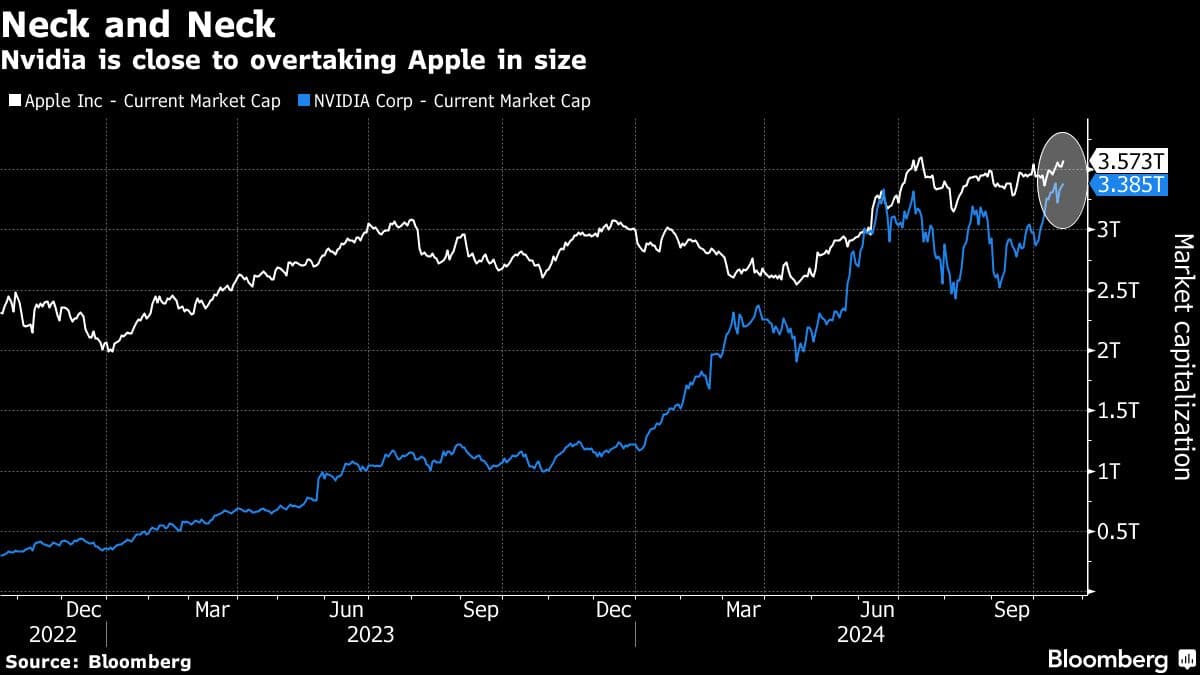
The biggest beneficiary of all this spending is Nvidia, whose chips dominate the AI accelerator market. The stock hit a new record high last week after CEO Jensen Huang assured that its new Blackwell chip was in full production and seeing strong customer demand. Nvidia shares are up more than 175% in 2024 and are poised to overtake Apple as the world’s most valuable company with a market value of nearly $3.4 trillion.
Other companies expected to benefit from the growing wave of AI spending include TSMC, Broadcom Inc., Arm Holdings Plc, Micron Technology Inc. and Advanced Micro Devices Inc., which is trying to loosen Nvidia’s grip on the AI market. accelerators.
However, even some of the winners are not immune to non-AI weaknesses. Just look at Broadcom. Its custom chips and networking semiconductors are used in data centers, but its stock price fell last month after reporting disappointing results in parts of its non-AI business.
“There will eventually be a value argument to be made for non-AI chipmakers and a time when the strengthening economy will cause demand to return,” said Tim Ghriskey, senior portfolio strategist at Ingalls & Snyder. “However, it is a question of timing. In the meantime, AI will remain a priority.
Marvin Evans is a finance and fintech professional with 20 years of industry experience, including more than a decade working across the fintech sector. He is the founder of Fintech Bits and Finjobsly, and writes about fintech markets, financial technology, industry trends, innovation and the evolving fintech workforce. His analysis combines hands-on industry experience with data-led research to provide practical insight into the companies, technologies and trends shaping financial services.
 6 mins read