(Bloomberg) — A recent hoax threatening violence that sent a South Carolina high school into panic was a false alarm, but it left the Lancaster County school district grappling with real questions about safety.
School officials could spend at least $2 million on AI-based systems to search for weapons in the district’s 26 buildings, as part of a $588 million bond awaiting approval by voters next week. The district’s security director was already considering improving security, but fear over the threat strengthened the case for investment.
The move reflects a national trend, as school districts across the country invest billions in fortification, from AI-based detection systems to bulletproof doors, driven by the specter of gun violence. The U.S. education and security sector, which includes higher education and is valued at $3 billion according to an IHS Markit estimate, has grown rapidly since the pandemic, largely driven by pressure from public and new funding streams from bond measures and federal aid.
But even as officials rush to fortify their campuses, critics say some technologies offer little more than false comfort.
“Districts are facing enormous pressure from parents and media attention, as well as specific incidents, to do something,” said Ken Trump, president of the National School Safety and Security Services, a consulting firm based in Cleveland. “These dynamics have become more intense than any time I have worked in school safety.”
Evolv Technologies Holdings Inc., the company behind the equipment Lancaster envisions, has seen demand skyrocket in the education sector. Its systems, capable of screening 2,000 students per hour, are already used in busy locations like TD Garden in Boston and the Metropolitan Museum of Art in New York.
“Our biggest thing is trying to keep everything out of our school,” said Lonnie Plyler, Lancaster security director.
But not everyone is convinced that more technology will make schools safer. Samantha Viano, an associate professor at George Mason University who is studying the impact of these technologies through a Department of Justice grant, says that while AI systems can provide peace of mind, their effectiveness in prevention of violence remains largely to be proven.
“A lot of money is spent on safety equipment, but little research proves it actually works,” Viano said.
Evolv has faced its own share of controversy. The company has been the subject of an investigation by the Federal Trade Commission over whether its AI equipment works as it claims, and the company is currently embroiled in a class-action lawsuit alleging that it overstated the capabilities of its products.
“We stand behind our technology and are proud to collaborate with hundreds of security professionals and sites around the world on their security plan, including more than 1,100 school buildings,” said Alexandra Ozerkis, Door -company wording.
For companies like Cobalt Service Partners, a private equity-backed buyer of access and security companies, school security represents the fastest-growing part of its platform. Co-CEO Tyler Hoffman says he continues to look for new companies to acquire. According to PitchBook data, private equity has closed more than 30 deals in the sector since the pandemic, while venture capital firms have invested more than $420 million in 37 deals since 2020.
“We realized that, in education in particular, the need and demand for security technology is particularly high and growing at a particularly high rate,” Hoffman said. “Given the prevalence of gun violence, this is a major concern for everyone.”
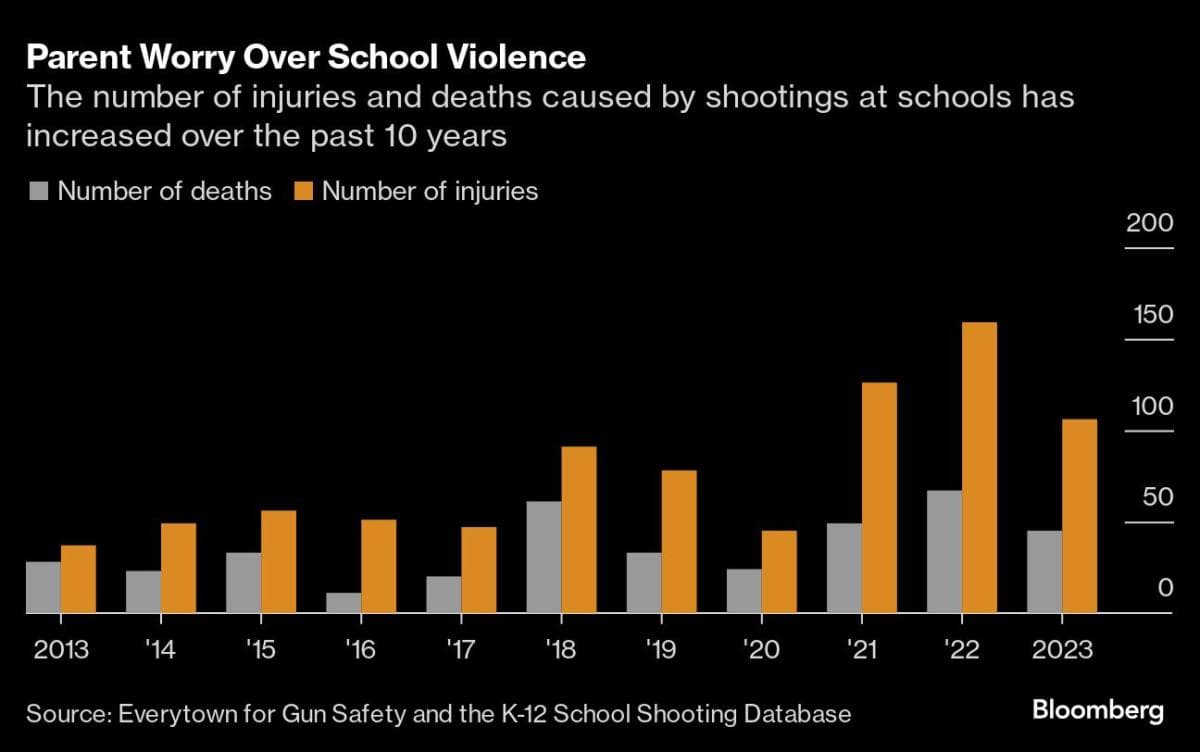
The increase in spending is rooted in high-profile school shootings that have shaped the national debate over campus safety.
Incidents such as the 2012 Sandy Hook shooting and the 2018 Marjory Stoneman Douglas High School massacre led to a wave of grants and legislation. Several states, including Florida and New York, have since approved “Alyssa’s Law” – named after Alyssa Alhadeff, killed in the Parkland shooting – which mandates panic alert systems in schools. Today, electronic notification systems, capable of automatically alerting police in the event of an emergency, are installed in more than two-thirds of American schools.
Nationwide, security cameras were present in about one in five schools in the early 2000s. Today, they are almost universal, according to the National Center for Education Statistics.
(Everytown for Gun Safety, a gun control advocacy organization, is backed by Michael Bloomberg, founder and majority owner of Bloomberg News’ parent company, Bloomberg LP.)
Hoaxes like the one last month in South Carolina — where screenshots of text messages threatening to kill teachers circulated on social media, triggering a flood of frantic calls and emails from parents — also fuel the culture of confinement.
Yet not all schools are rushing to adopt a fortress mentality. The Santa Monica-Malibu Unified School District in California, for example, told parents it was moving toward more open campuses while focusing on wellness services, building modernizations and increasing of supervision.
Other places have gone to the extreme, implementing a series of toughening measures, including bulletproof offices. West Elementary School in Cullman, Alabama, is testing collapsible bulletproof shelters, made by KT Security Solutions. In March, New York State Governor Kathy Hochul announced a $21 million plan for high-tech school security.
Still, experts like Jagdish Khubchandani, a professor at New Mexico State University who studies school gun violence, warn against too much reliance on these expensive technologies. “What is the foundation of this industry? Nobody knows,” Khubchandani said. “A lot of money is spent on these hardening processes, but there is little evidence of their effectiveness. »
Khubchandani published an academic article in 2019 stating that “none of the gun violence prevention methods currently used in schools have empirical evidence demonstrating that they actually decrease gun violence in schools “. A separate 2022 study by a team of researchers from Florida State University, the University of Cincinnati and the University of Nebraska Omaha came to a similar conclusion.
However, for many school administrators, the priority is peace of mind for parents and students.
Adam Neely, principal of Prescott High School in Arizona, said his school’s investment in an AI-based security system has already shown its value in non-violent situations. Since integrating a Volt AI system into the school’s existing cameras in 2022, various incidents have been reported. In one case, he detected a student suffering an asthma attack in a hallway; in another, he alerted staff to student thefts in the theater department.
“We often felt like we were constantly in reactive mode,” Neely said. “I can imagine a lot of schools today are looking for something like this.”
Trump, the security consultant, agreed, but warned against schools rushing to invest in products they don’t fully understand.
“Parents are upset, attention is heightened, and superintendents and school boards are responding by implementing physical, reportable solutions,” he said. “Often this produces security theater, simply the perception of greater security. »
Most read from Bloomberg Businessweek
©2024 Bloomberg LP
 6 mins read