(Bloomberg) — A Texas land company founded in the Wild West era more than a century ago is becoming an unlikely beneficiary of the market’s euphoria over artificial intelligence.
Most read on Bloomberg
Dallas-based Texas Pacific Land Corp., which employs 100 people, has seen its stock more than triple this year, giving it a market value of nearly $40 billion. That’s bigger than Halliburton Co., North America’s largest oilfield services provider, and asset manager State Street Corp. That’s more than four times the size of American Airlines Group Inc., based near Fort Worth and with more than 100,000 employees.
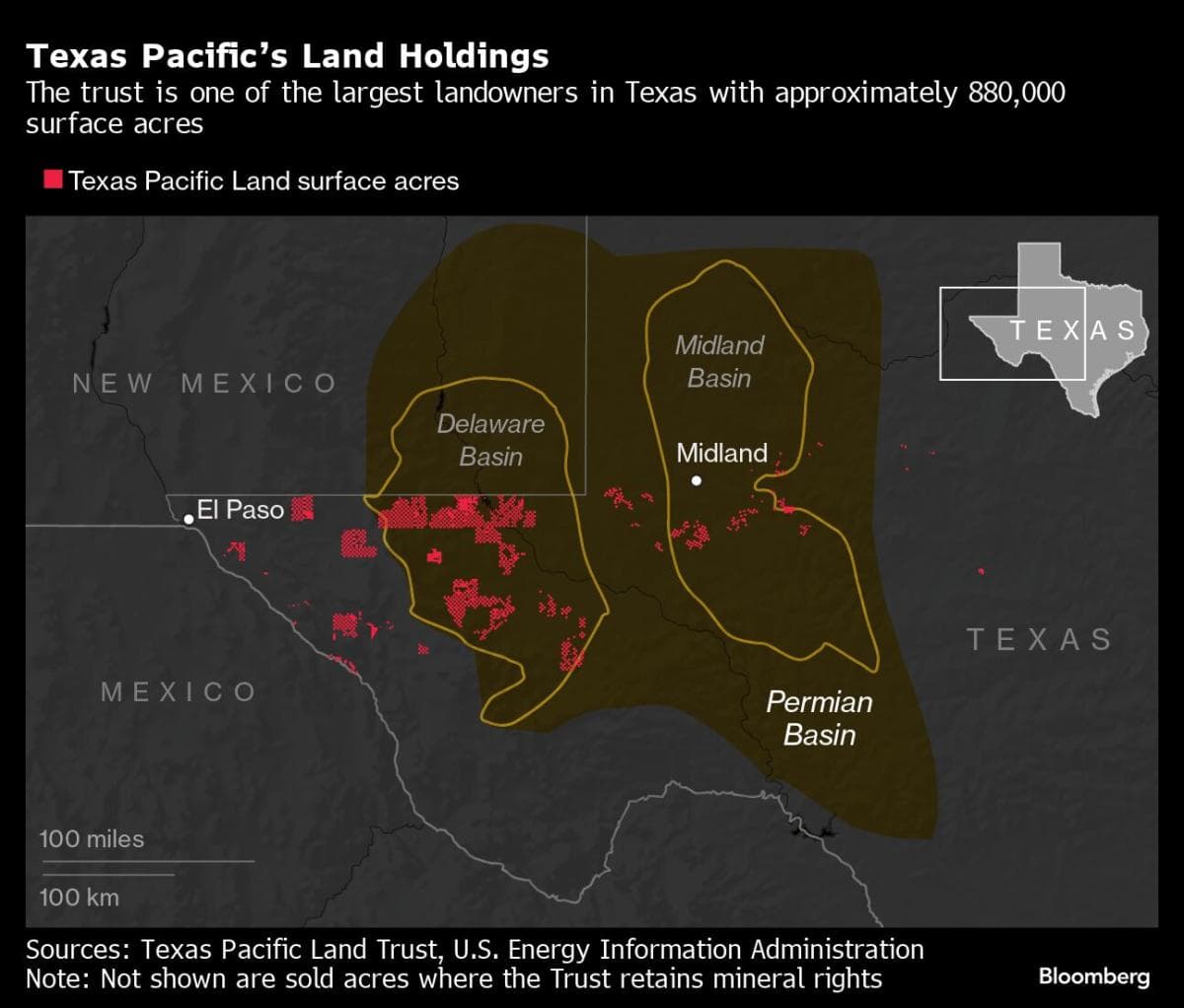
Bitcoin mines, large-scale batteries and renewable energy are already being built on TPL’s 873,000 acres in West Texas, an area larger than Yosemite National Park. But perhaps this is just the beginning. The swathe of land in the oil-rich Permian Basin, where natural gas costs next to nothing, presents an opportunity for tech giants like Google-owner Alphabet Inc., Microsoft Corp. and Amazon.com Inc., to access cheap electricity for their energy-intensive servers. .
TPL shares jumped 14% Friday on news of Marathon Oil Corp.’s replacement. in the S&P 500.
“There’s a lot of discussion going on within the industry and certainly within TPL” about leasing land for data centers, TPL CEO Tyler Glover said this month at a conference call with investors. “We believe we are as well positioned as anyone in West Texas to provide land and water solutions as these opportunities arise.” »
AI’s potential to revolutionize the way people live, work and play has been the driving force behind the 50% rise in the S&P 500 over the past two years. But to realize the real profits implied by the valuation of their stocks, Big Tech invests money in physical infrastructure. Alphabet, Microsoft, Amazon and Meta Platforms Inc., which owns Facebook, are expected to spend more than $200 billion next year, according to data compiled by Bloomberg, much of it on data centers.
“A lot of different sectors will benefit,” said Greg Halter, who helps manage $4 billion as director of research at Carnegie Investment Counsel. “These strange entities are reanimated because all of a sudden they have something valuable.”
A TPL spokesperson declined to comment. The company’s shares have jumped 230% this year to trade at $1,730 on Friday.
The high-tech rally is a far cry from TPL’s roots as a trust founded in 1888 to reimburse bondholders who financed a failed attempt to build a railroad between East Texas and San Diego during its westward expansion. The trust gained 3.5 million acres, an area the size of Connecticut, and slowly sold them off to pay off its creditors over the next century. But land in the arid, sparsely populated western part of the Permian Basin has proven the hardest to sell.
The acreage turned out to be a multibillion-dollar fluke. When the shale revolution took off in the 2000s, this land – and the mineral rights associated with it – became incredibly valuable. TPL now receives nearly $100 million a quarter in royalties from oil producers like Exxon Mobil Corp., Chevron Corp. and ConocoPhillips, without paying anything for the cost of their wells. In the most recent quarter, it earned an additional $80 million from water sales and royalties paid to companies using its land, contributing to an 83% profit margin.
At least one other Texas landowner has benefited from investors’ enthusiasm for AI. LandBridge Co., which owns about 220,000 acres in the Permian, has more than tripled since going public in June. The company agreed to buy more land this month in a deal that would increase its square footage by 20%, citing the potential for “digital infrastructure and renewable energy projects.”
Along with TPL and LandBridge, utilities and energy stocks are among the biggest beneficiaries of the AI push, with Vistra Corp., GE Vernova Inc. and Constellation Energy Corp. all appearing in the top 10 of the S&P 500 this year. Pipelines that supply gas to power plants are also flying. Kinder Morgan Inc., Oneok Inc. and Targa Resources Corp. are all up more than 50% this year.
“This is an AI-adjacent pick-and-shovel business,” said Kevin Simpson, who helps manage $11 billion, including TPL stocks, as CEO of Capital Wealth Planning LLC . “These are not obscene assessments if the data center thesis holds true.”
Investors are now thinking further. With a ChatGPT query consuming nearly ten times more electricity than a Google search, energy demand for U.S. data centers is expected to grow about 170% by 2030, according to Goldman Sachs Group Inc. “This increased demand will help drive the electricity type of growth. this has not been seen in a generation,” the bank said in May.
Sam Altman, founder of OpenAI, owner of ChatGPT, floated the idea of five gigawatt centers. This could require millions of square feet of space and enough energy to light many U.S. cities. There are concerns that data center electricity needs could put climate goals at risk as companies turn to fossil fuels to power them.
The Permian appears well positioned to meet at least part of the energy demand. The basin produces huge quantities of natural gas as a byproduct of petroleum, filling pipelines to capacity. Much of the excess is burned into the atmosphere in a process called flaring. Gas from the Waha Basin hub has traded on average 96% cheaper than the U.S. benchmark price over the past year, and Permian gas prices have actually gone negative over once this year, the producers having paid to have the fuel taken away from them.
The idea that this abundant and cheap gas could be used for power plants, which in turn could provide energy to data centers, cryptocurrency mines and oil fields, is now gaining ground. magnitude. Still, the market for some AI-adjacent stocks could get frothy, at least in the short term. Simpson, of Capital Wealth Planning, said he recently reduced his position in TPL by a third after the stock soared 40% in a month.
It’s too early to tell whether the TPL land will soon be home to large data centers, according to CEO Glover. But the company is in a prime position to benefit from the expansion of AI, he said.
“TPL has many benefits for data centers,” he said. “Nobody has more land than us in West Texas.”
Marvin Evans is a finance and fintech professional with 20 years of industry experience, including more than a decade working across the fintech sector. He is the founder of Fintech Bits and Finjobsly, and writes about fintech markets, financial technology, industry trends, innovation and the evolving fintech workforce. His analysis combines hands-on industry experience with data-led research to provide practical insight into the companies, technologies and trends shaping financial services.
 6 mins read